

Arbitrators and Sabermetrics
If you ever wonder why Bill James became big when he became big, I think this article might provide some insight:
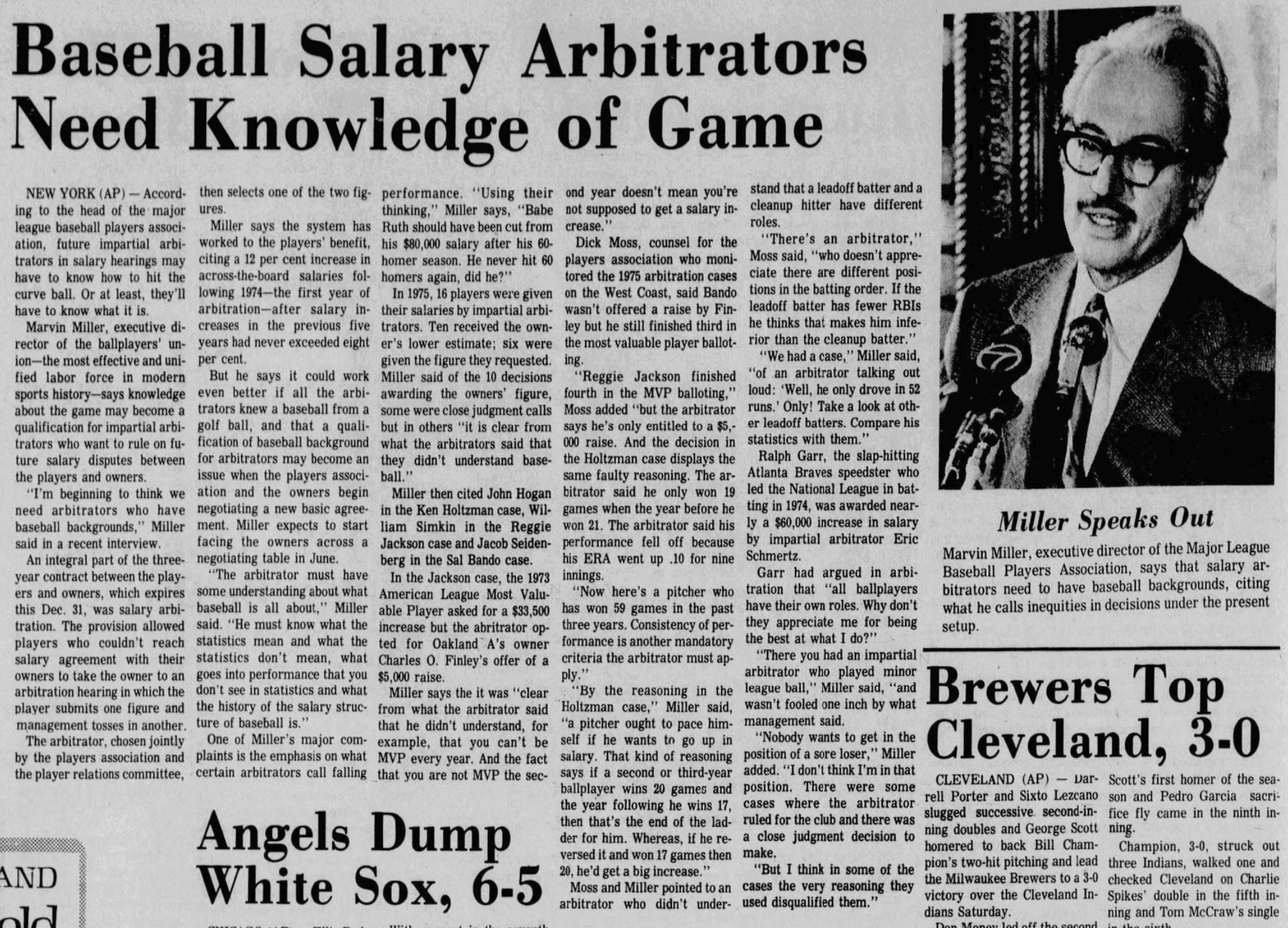
You see, the early years of baseball arbitration weren’t exactly the best from a scientific perspective. And the problem lay in the lack of an effective way to statistically measure the value of baseball players against each other.
This article was printed in April 1975, of course. We were still a few years away from the development of The Bill James Baseball Abstract, a book that really didn’t become anything big until early 1982.
But you can see the seeds of Jamesian thinking in this article. I mean, just look at what Marvin Miller is talking about here. Per Martin, arbitrators didn’t understand:
The fact that big name stars cannot possibly win the MVP award every single year
The fact that winning 19 games instead of 21 as a pitcher is not necessarily a big step backwards
The fact that an increase of 0.10 in ERA from one year to the next is not statistically significant or indicative of anything
The fact that leadoff hitters naturally have fewer RBIs than cleanup hitters
And I’m sure that there were more points that simply didn’t make it to press.
The funny thing, of course, is that these are all points that Bill James made throughout the early years of the Abstract. And, interestingly enough, research into sabermetrics and the way baseball players actually compete with each other wind up helping players earn a lot of arbitration victories as time went on.
Of course, it’s a wonderful thing to be able to research baseball in a way that is actually relevant and meaningful. But you probably didn’t realize that there were financial incentives behind it from the beginning.
I don't see it. Presumably by the 1980s the arbitrators had been educated on the points mentioned in the article and your summary. But runs created and the like weren't going to mean anything to them. They might or might not have meant much of anything to the people presenting the players' cases, but it'd be foolish or desperate for them to build a case around those. Further, the arbitrators have instructions as to the factors on which to base their decision. An advocate would have had to convince the arbitrator that the new information was germane to those. Even then, they'd have to judge their importance: range factor might look like a crucial element of defense, but if so, why hasn't anybody been calculating it until now? Finally, perhaps the most important point: if all the non-arbitration players that your guy is bring compared to aren't getting rewarded for, say, on-base percentage, it's very probably irrelevant to the arbitrator how much it helps the team; he shouldn't be paid for it either.