

Artificial Turf and Fielding
Most people in modern sabermetrics don’t care about artificial turf anymore.
It was big news in the 1980s and early 1990s, back when it seemed that every new stadium would have some kind of artificial surface. The trend reached its peak with the opening of the Skydome in Toronto in late 1989.
But we don’t see any more traditional artificial turf stadiums these days. And, frankly, the statisticians have tended to ignore its effects over the years.
I was thinking about this the other day when I saw this article at the front of the June 1982 issue of The Baseball Analyst:
Okay - if you have never heard of The Baseball Analyst, don’t worry. Yes, you can find old issue for free at The Society for American Baseball Research. But if you’ve got a short attention span and don’t want to read hundreds of pages of obsolete sabermetrics, never fear. I’m happy to help you out.
Schwarzenbart starts off with a premise that most of us have forgotten: that artificial turf allegedly had a major impact on baseball fielding:
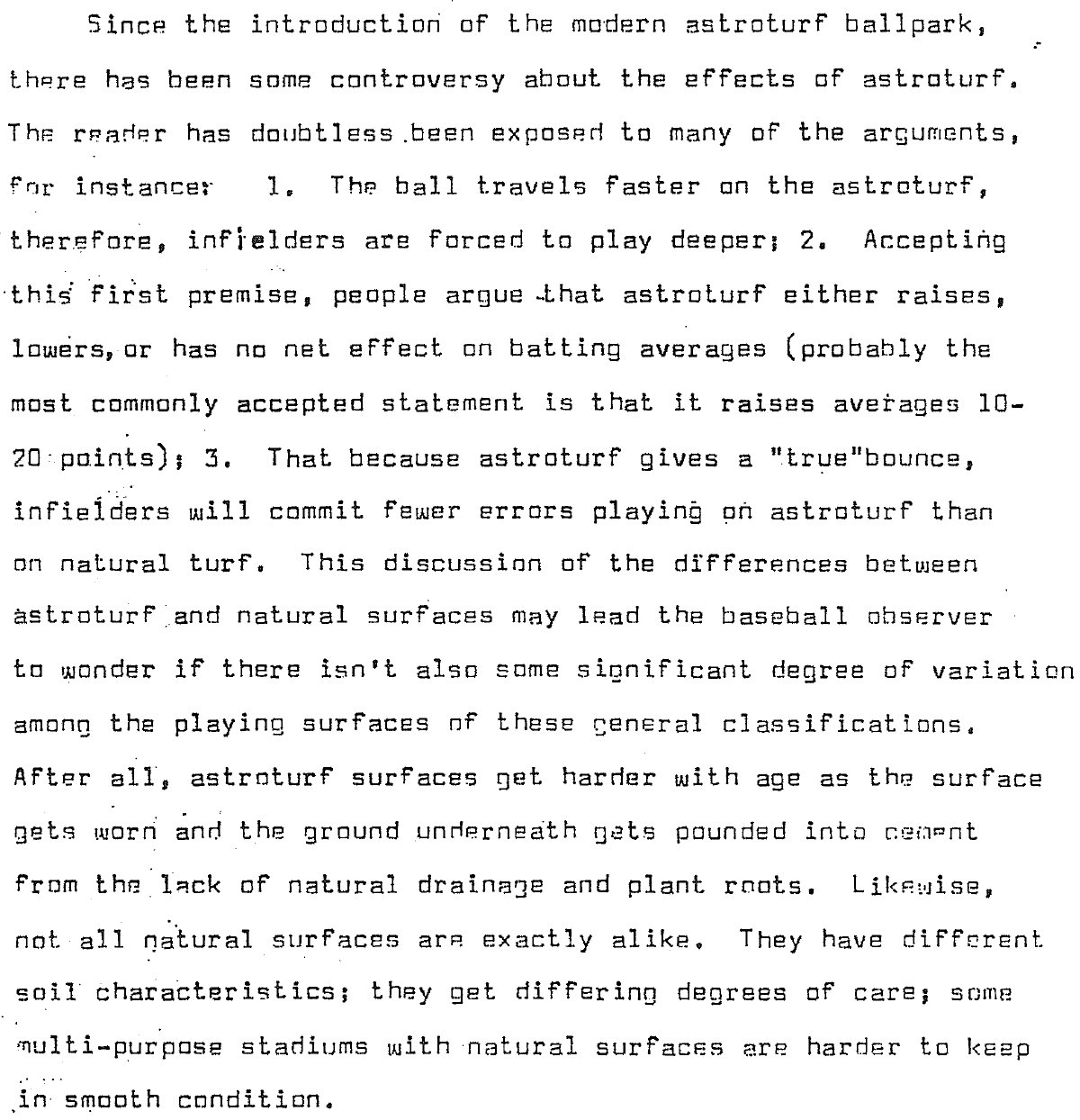
Since this is back when personal computers were still a novelty and baseball statistics were a closely guarded government secret, poor Paul had to do a lot of the statistic compiling by hand. Like so many others in that era, he compiled fielding statistics by hand from old Sporting News boxscores.
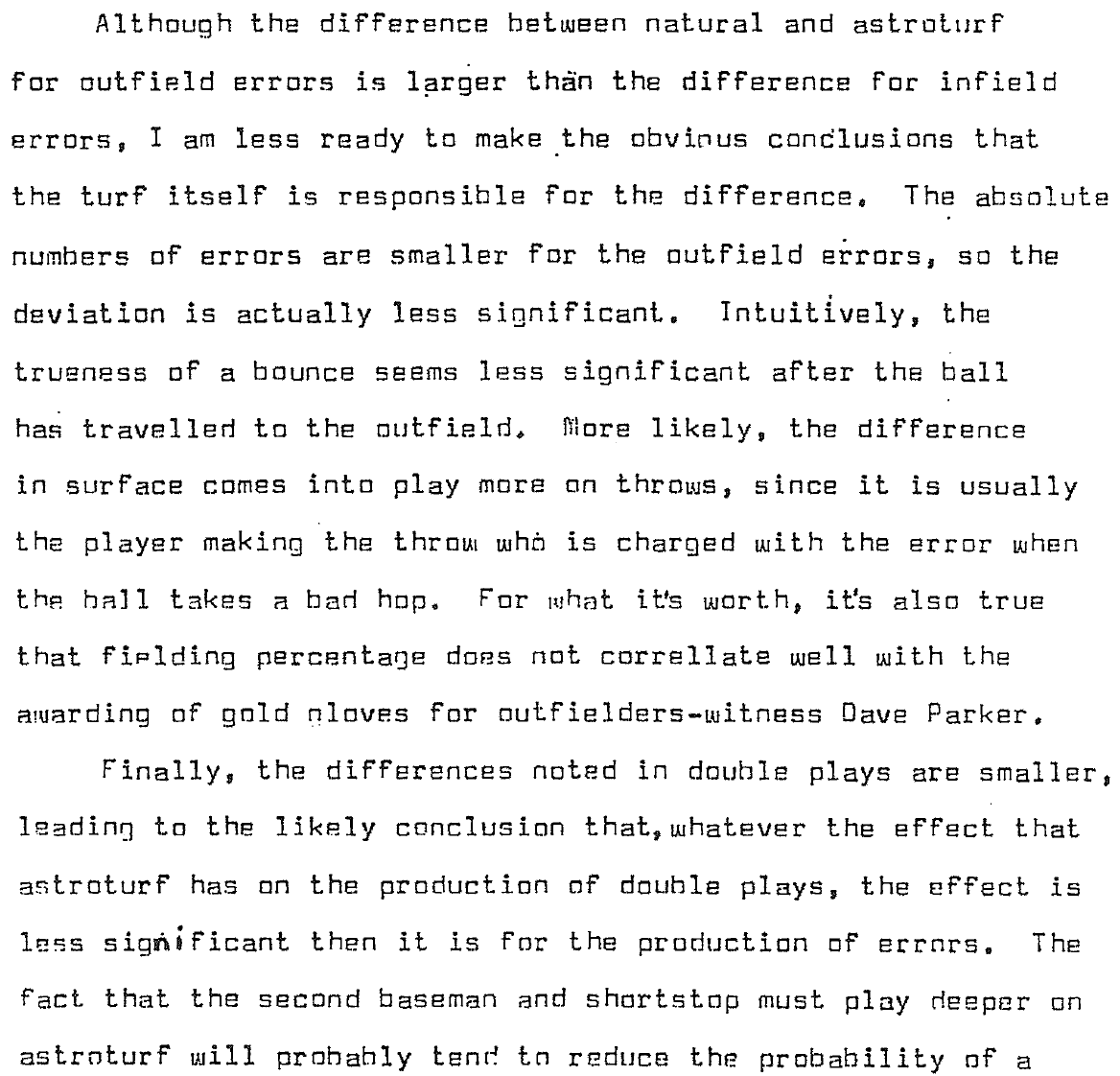
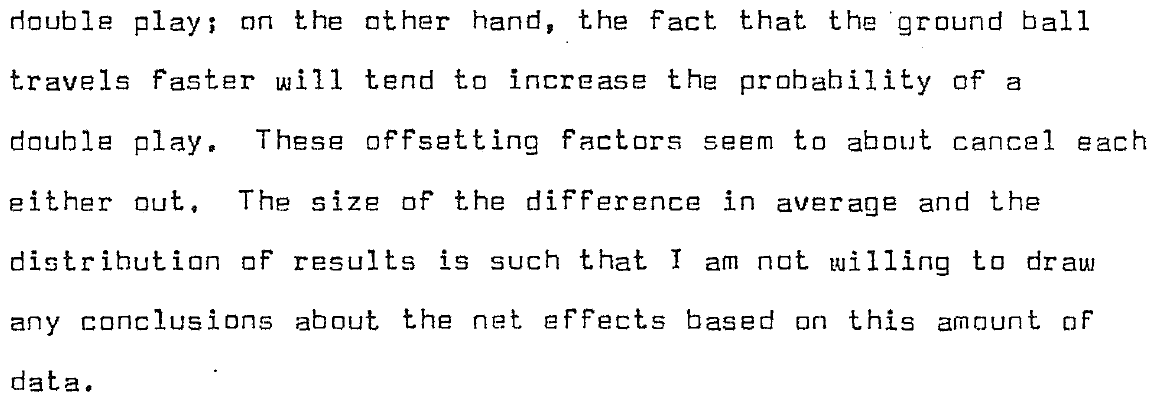
I’m actually going to skip over his statistical findings, since they’re not all that well defined or easy to understand. The interesting thing is that his conclusion is that artificial turf tended to increase errors, but apparently had very little impact on the number of double plays turned:
Now, the really cool thing about our current era is that we can quickly see the impact these ballparks had without having to dig through a bunch of old boxscores and do the math by hand.
Since I’m planning on starting a 1982 project with PC Replay Baseball in the near future, I decided to look at that season.
Now, first thing’s first. There’s really no evidence that artificial turf parks had a significant impact on hitting. In fact, the rate statistics (batting average, OBP, slugging percentage, etc) are almost the same between games on grass and games on turf:

This is true for any season with numerous artificial turf stadiums, by the way. While those rate statistics are not exactly the same, it’s close enough for you to conclude that there was no major effect. Or, in other words, if you did a full replay of 1982 and came up with a batting average that was .001 points off, an on base percentage that was exactly the same, and a slugging percentage that was .005 off, you’d conclude that you had a pretty accurate replay.
Now, Baseball Reference unfortunately doesn’t show us things like double plays or errors per game. We’ve got to do a little bit of work to get to those statistics.
First, though, we should take a look at stolen bases and caught stealing per game based on ballpark type:

As you can see here, it was slightly easier to steal bases in artificial turf stadiums than on grass.
We can also look at double plays:
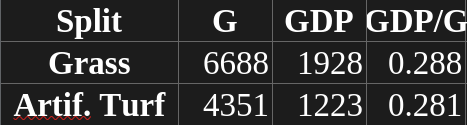
Surprisingly, double plays per game were basically the same regardless of the type of surface.
My guess is that players became accustomed to playing in different positions when they were playing on artificial surface. If you watch a lot of Cardinals games from the 1980s, you’ll notice that Ozzie Smith played a few steps deeper on artificial turf to adjust for the speed of the ball coming off the turf. Or, in other words, there’s really not a lot of evidence that fielders at the major league level had a difficult time adjusting for the challenges artificial turf brought.
We can also look at the number of times batters reached base on an error:

Interestingly enough, this contradicts Schwarzenbart’s conclusions - though I’d argue that the numbers are so close that they’re practically identical.
Notice, by the way, that Baseball Reference is only giving us the number of times a runner reached base on an error. It’s possible that these statistics would be different if we could simply see all errors split by ballpark type, which, unfortunately, is not a statistic that we have access to.
If you watch a lot of old artificial turf baseball games, you know that there was a difference between how the game was played on turf and how it was played on grass. However, the aggregate statistics indicate that the difference between the two kinds of baseball was actually negligable. And you’ll see similar results regardless of the season you look at.
I grew up watching and listening to Phillies games, and I heard a lot about "turf bounces", balls hitting seams, taking bad hops, etc. It's quite enlightening to consider how this integral part of the game in the 1970s and 1980s actually affected the statistics. One of my favorite junk wax sets, the 1988 Fleer, put splits on the back of their cards for night vs. day and home vs. away. This was talked about periodically during games, but that's the first I remember seeing them on a baseball card. The proliferation of stat collecting actually hinders my enjoyment of the game by cluttering it with useless information ("exit velocity" really annoys me). My opinion of stats is that if it wasn't on a baseball card in 1986, it doesn't matter. That really tells you my mind is at most of the time!
Ah, I love this stuff about early baseball research. I can't imagine having to compile all that stuff by hand!
The impact on stolen bases is interesting, I would have thought it had more of an impact. Those were the days of 100 SB players like Rickey and Vince Coleman!