

Minimum Wage
I recently completed an OOTP project. You’ll find out more about it in the next few days, as I piece together some of the data and figure out a way to present it that makes sense.
If you’ve ever played a multi-year OOTP project, one thing you’ll notice right away is the massive changes in the finances of baseball teams over the years.
OOTP actually does a good job of modeling this. If you play as a small market team - for instance, the Kansas City Royals - and start in the 1990s, you’ll find it harder and harder to afford big name free agents as time goes on. In the beginning, you might be able to stretch your budget out a bit and afford one or two of the major free agents on the market. Near the end, however, you’ll see your best players leave once their contracts are up, since the media revenue discrepancy basically prices you out of the free agent market.
The other thing you’ll notice over time is that the minimum wage rises.
Now, the rise in minimum wage in OOTP seems to me to be accurate. However, from the General Manager perspective, you’ll notice that the difference between the average free agent price and minimum wage actually grows over time. In fact, once your save starts hitting the mid-2000s, you’ll notice that players who win arbitration battles with you wind up earning 7 or 8 times the minimum wage, something that is not the case if you start in the early 1990s (or, even better, in the early 1980s).
Anyway, when I noticed this phenomenon, I became interested in trying to understand what was happening in real life. And, well, questions such as “what were the minimum salaries every year” are actually really hard to answer.
There have been some studies over time that skirt around these topics. For example, there was a great article that was on the Economic History Association website years ago by Michael J. Haupert called The Economic History of Major League Baseball. It doesn’t give us minimum wage values, but it gives us at least an idea:
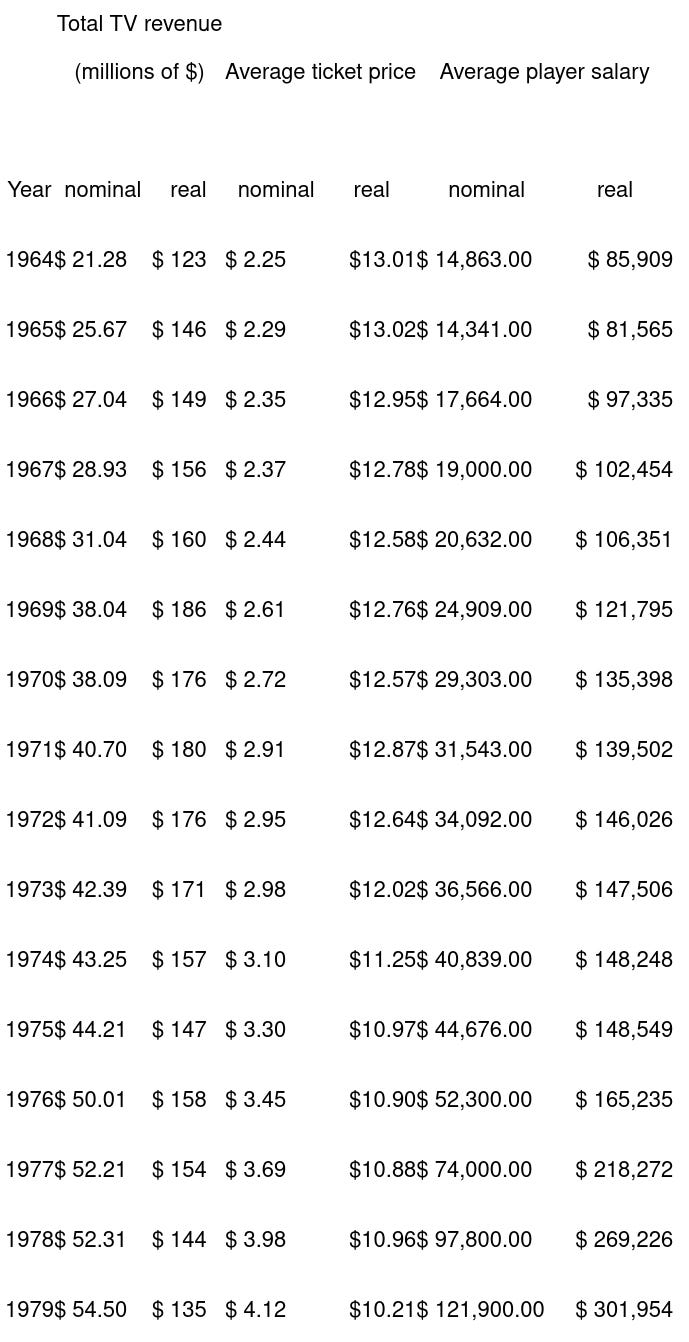
The interesting part to us here is the “nominal” wage data, or the unadjusted wage. However, I have no idea what precisely the source of this data is. And, of course, you’ll notice that the information provided is the average wage, not the minimum wage.
I should note that you can still find the article on this page. However, a number of the images are broken, and the formatting is not t
A quick Google search for historic baseball minimum wage data will bring up this Baseball Almanac site, which seems to be actively updated.
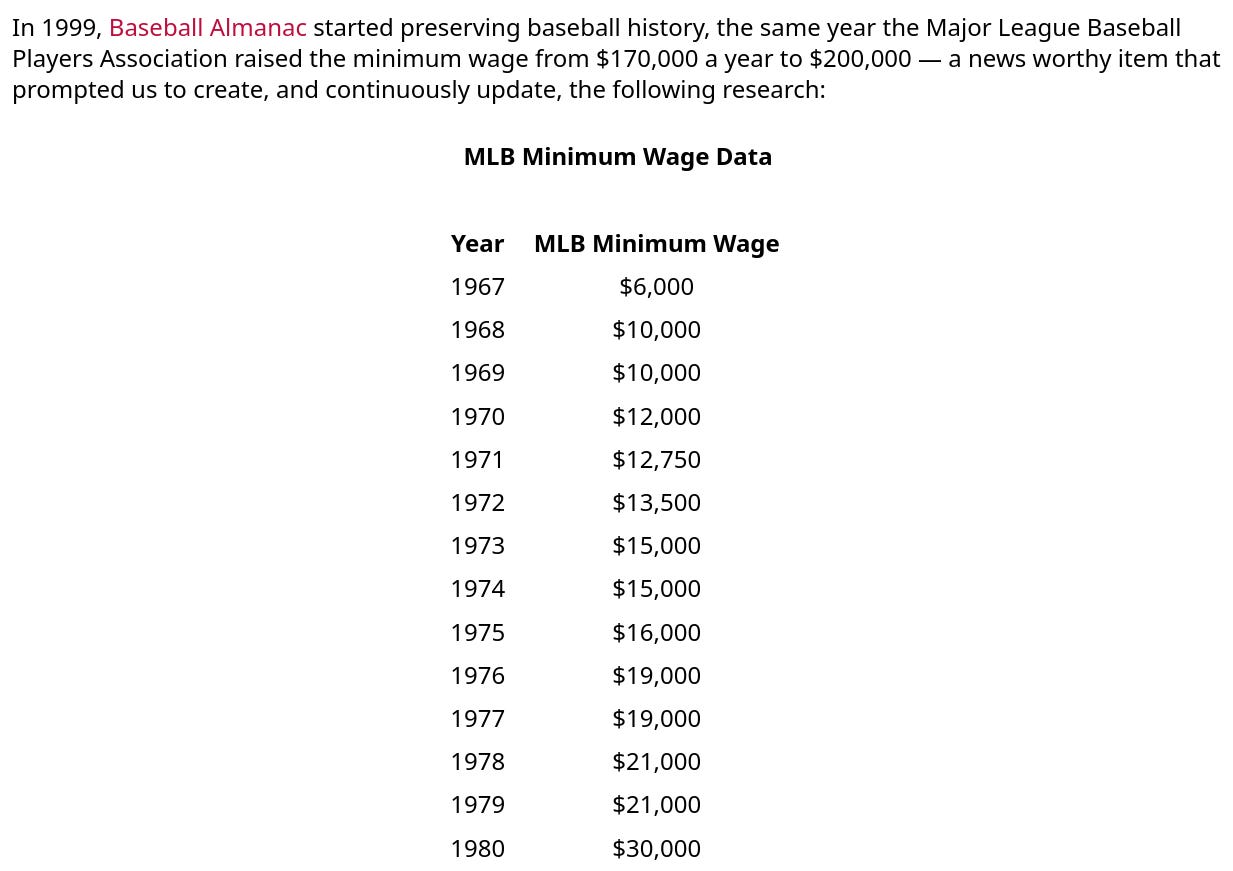
The problem, however, is that there’s no source for these numbers. And, sadly, they don’t appear to be accurate.
I did a quick search of newspapers to see if I could find evidence of that $6,000 minimum salary in 1967. And this is what I came up with:
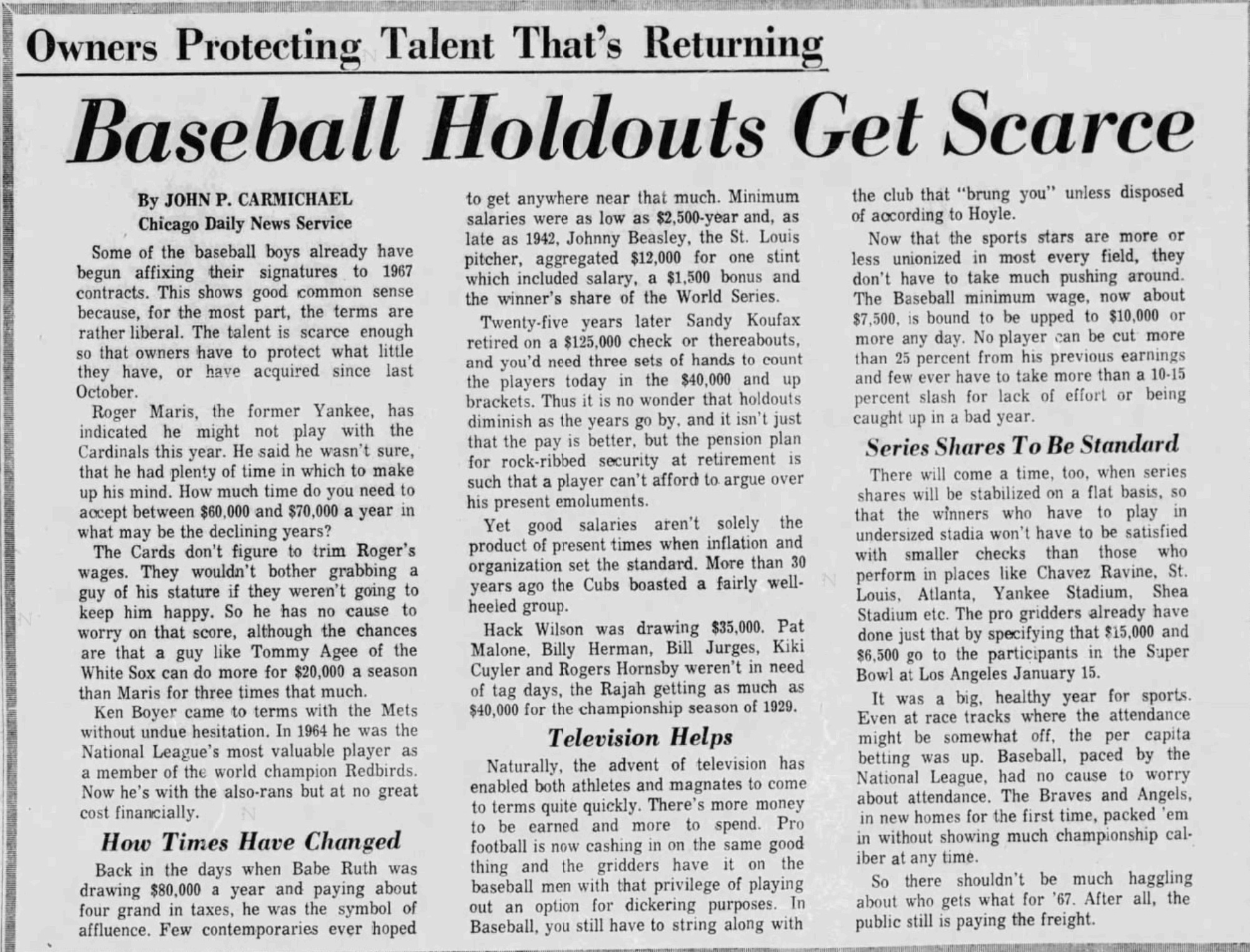
If you read carefully, you’ll notice that the baseball minimum wage here was reported to be “about $7,500.” And the problem, of course, is that this was printed on January 1, 1967 - which means that the Baseball Almanac information is wrong.
The other thing you’ll notice is that there were minimum salaries in Major League Baseball before the mid-1960s. It’s reported here that the minimum was as low as $2,500 a year in the 1920s.
In fact, you can find at least some references to baseball’s minimum wage in newspaper articles before the 1960s. Check out this one from 1950, also from New Jersey:
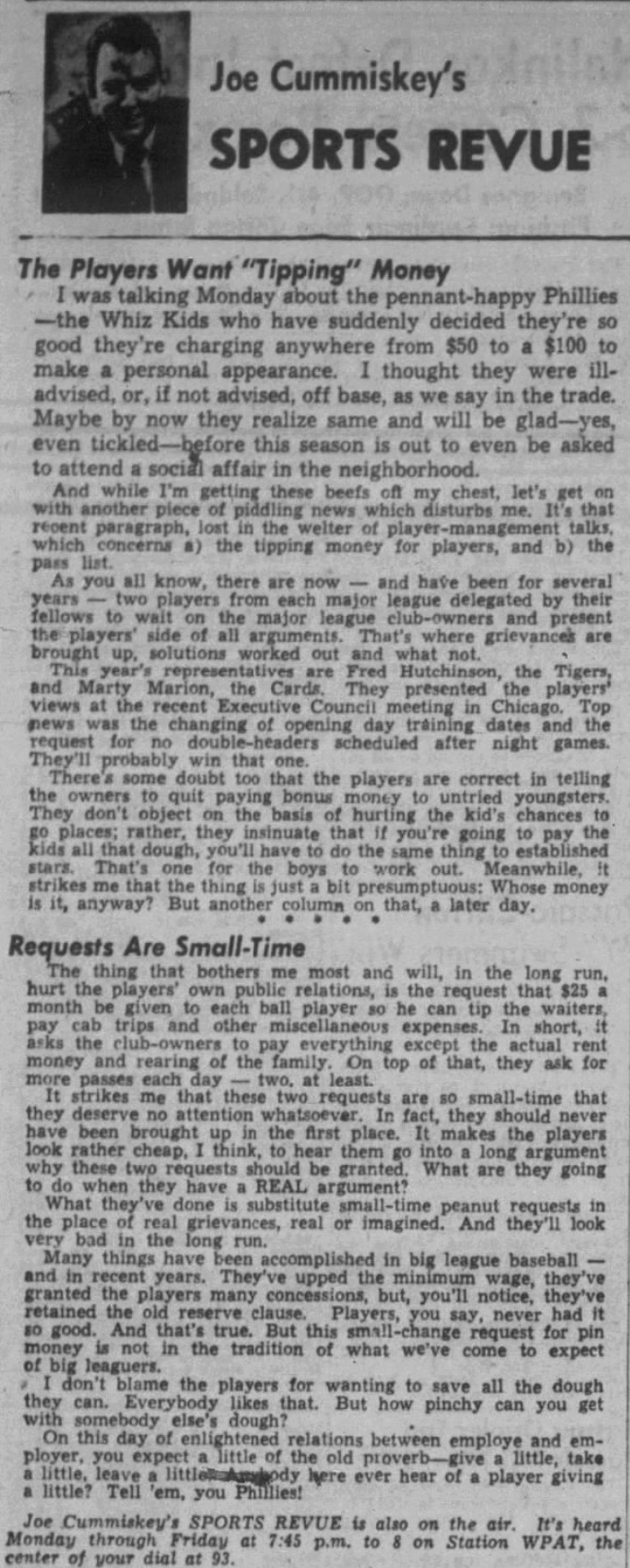
What precisely was the minimum salary in 1950? This article doesn’t tell us, but it does tell us that there was a minimum salary.
Anyway, this is an issue that needs more careful attention and actual source citations.
It’s similar to a table I see passed around every now and then on historic roster limits. I believe that list originated on the OOTP forums a few years back. It’s completely inaccurate, and ignores things obvious to careful students of the history of the game, such as the fact that the American League tried to establish a roster size limit in 1901 but failed.
In general, it would be nice if people who put together these historic numerical reports actually bothered to cite some sources. I strongly suspect that a lot of the statistical data that goes into games like OOTP was invented out of necessity, sort of on this “trust me bro” basis.
According to the 1947 Baseball Guide and Record Book, at least for the 1947 season going forward, the minimum MLB salary was $5,000.
“Guarantees in the new contract form include a minimum salary of $5,000 a year; no diminution of salary on assignment…”
It appears to have stayed at $5,000 in 1950, based on testimony in the House hearings on whether organized baseball was a monopoly. Former player Cy Block testified to this amount. Block has an interesting history, based on his SABR coverage.
At some point between 1951 and 1954, it must have been raised to $6,000 a year. According to a SABR article on the 1954 winter meetings, player reps asked for an increase from $6,000 to $7,200, but the owners rejected it.
It then stayed at $6,000 a year until 1968, when the new CBA increased it to $10,000 a year.
This is what I was able to gather, at least from searching via AI. Since SABR openly shares its research, as well as the TSN Guides many are online. AI was able to find and connect some of these pieces.