

Next Year
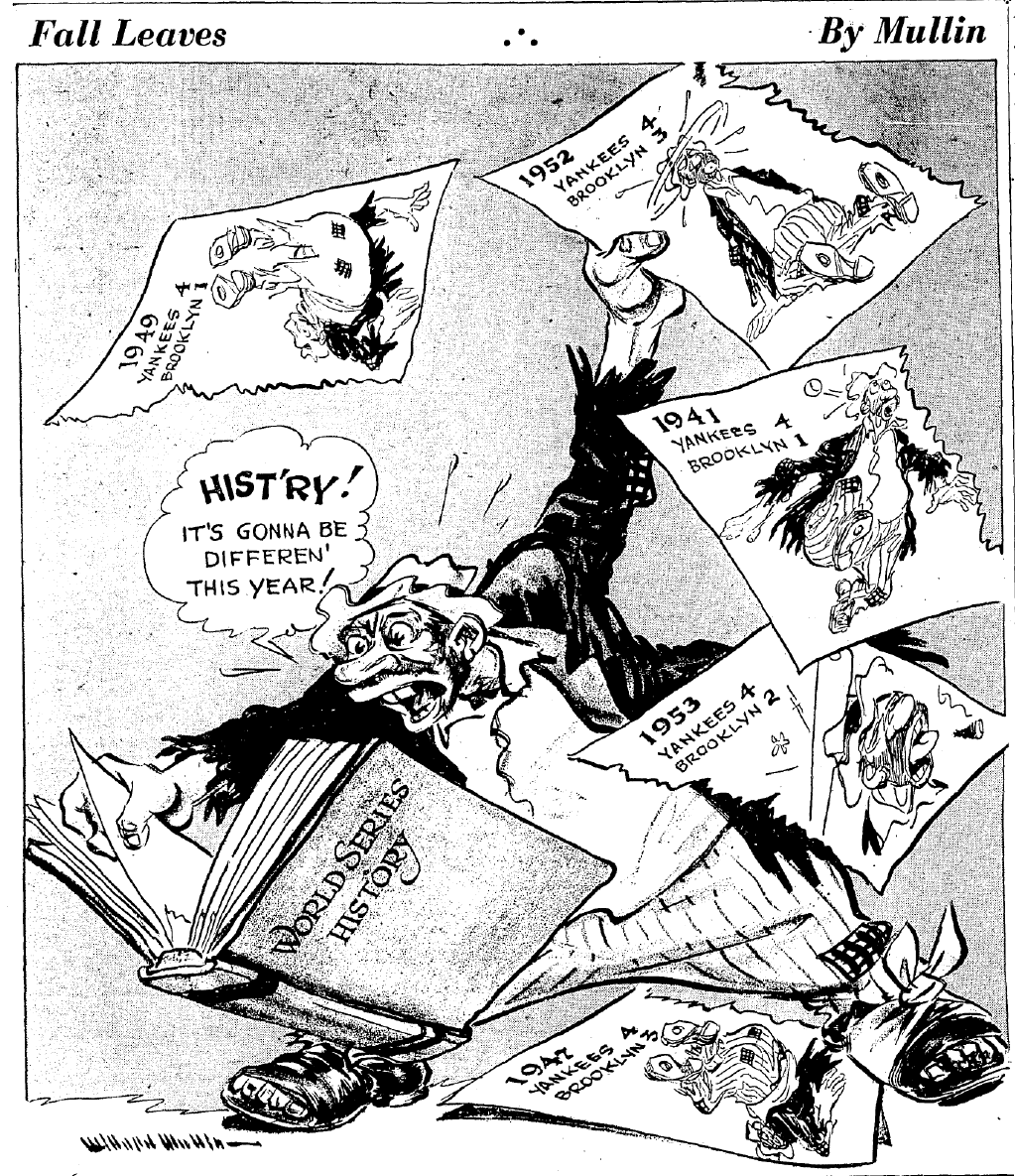
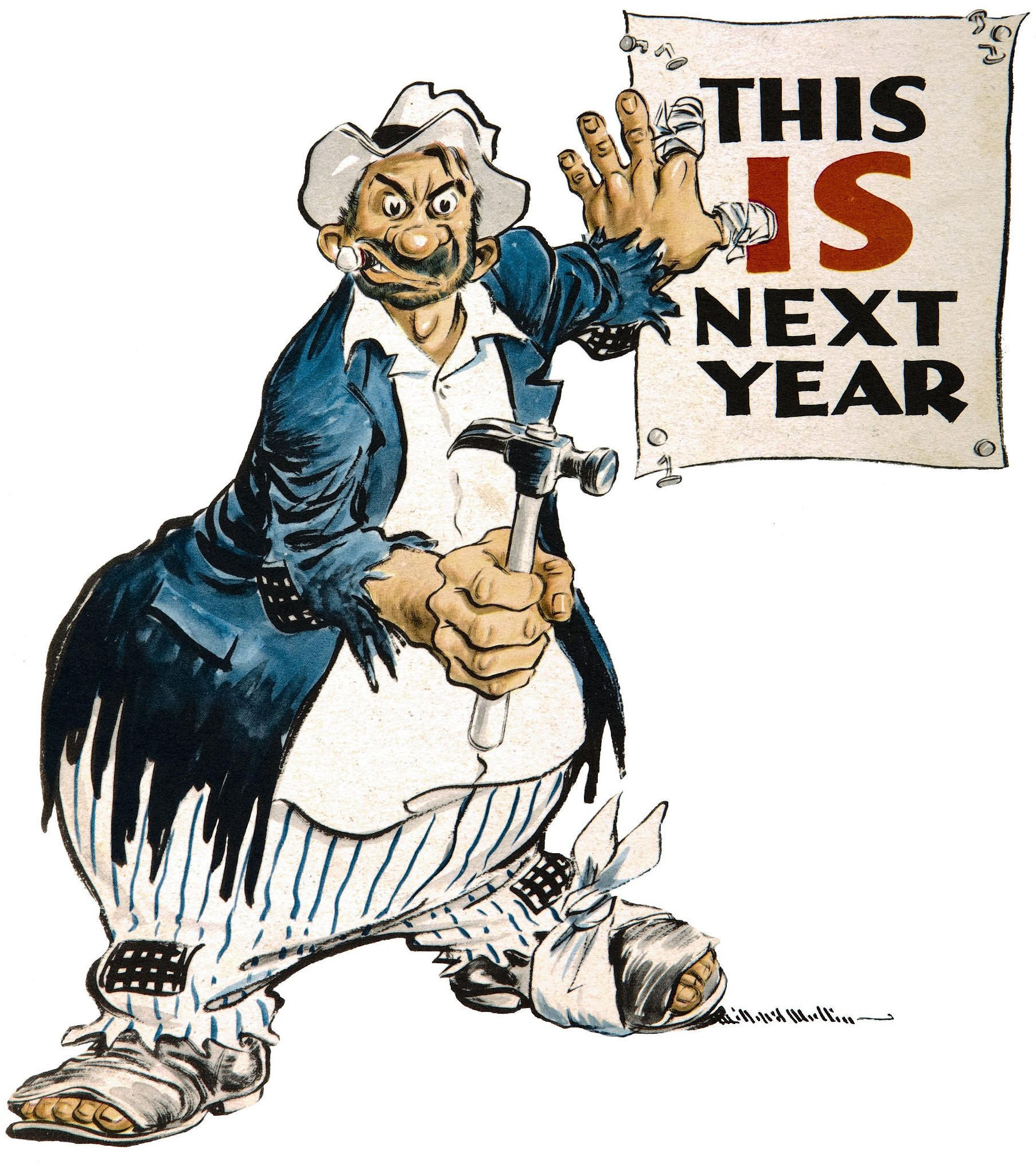
Willard Mullin probably didn’t realize it, but his cartoon here is actually extremely historically accurate.
If you go through the pages of the history of the Brooklyn Dodgers, it seems that the team could never win a championship the “legitimate” way.
After winning the 1889 American Association pennant but losing to the New York Giants 6 games to 3 in the World series, the Brooklyn Bridegrooms moved over to the National League. Brooklyn won the league championship, thanks in large part to the rest of the league being weakened by defections to the Players’ League.
But Brooklyn couldn’t come out on top in its repeat trip to the early version of the World Series:
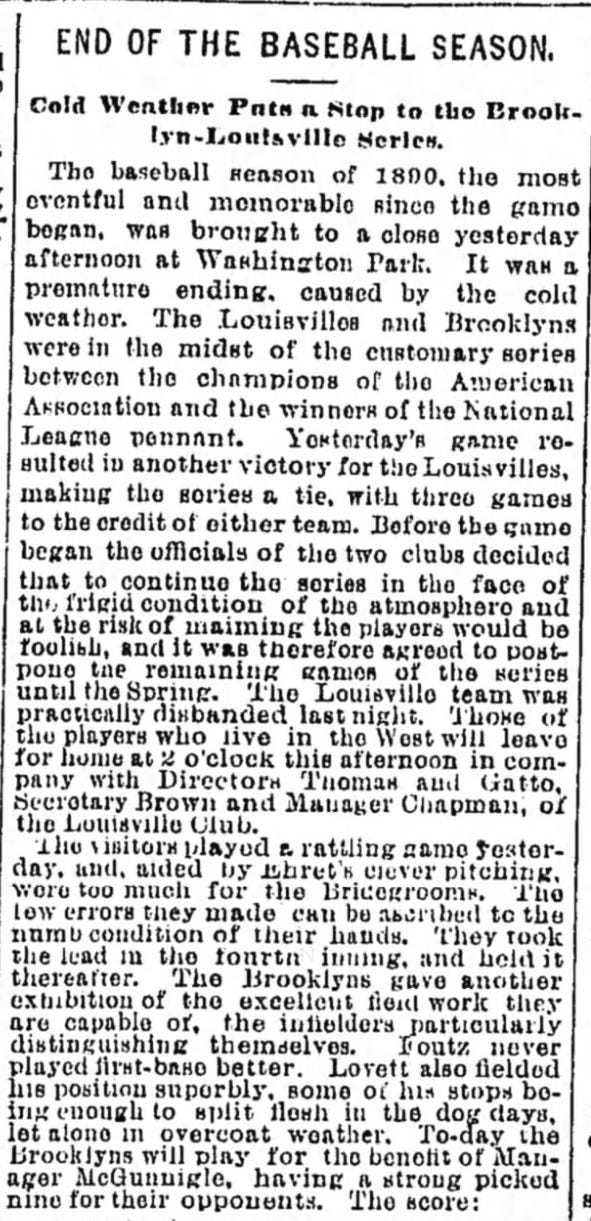
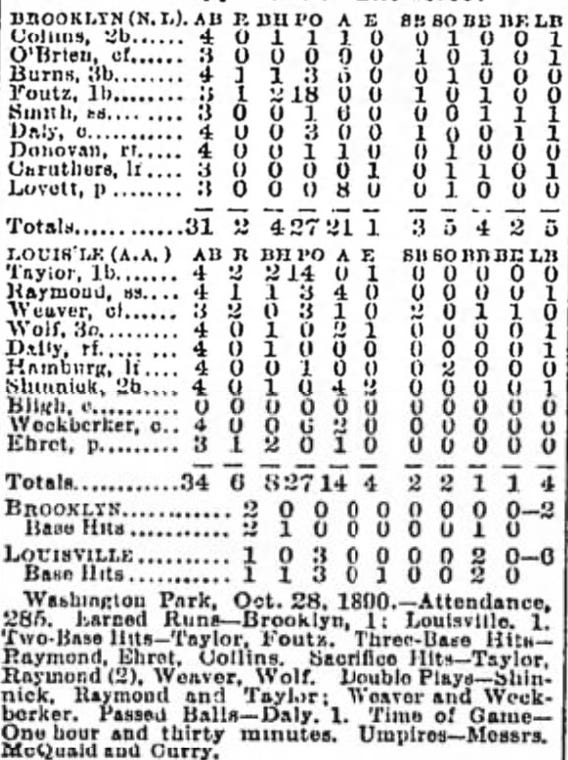
And, yes, that attendance figure of only 285 at Washington Park is no typo. The game was a lot different way back when.
Brooklyn meandered through the 1890s until encountering a sudden stroke of managerial luck. In late 1898, Baltimore Orioles owners Harry Von der Horst and Ned Hanlon wound up purchasing the Brooklyn franchise, which had finished in 10th place and was simply awful. Von der Horst and Hanlon then took the best players of the Orioles and transferred them over to Brooklyn overnight:
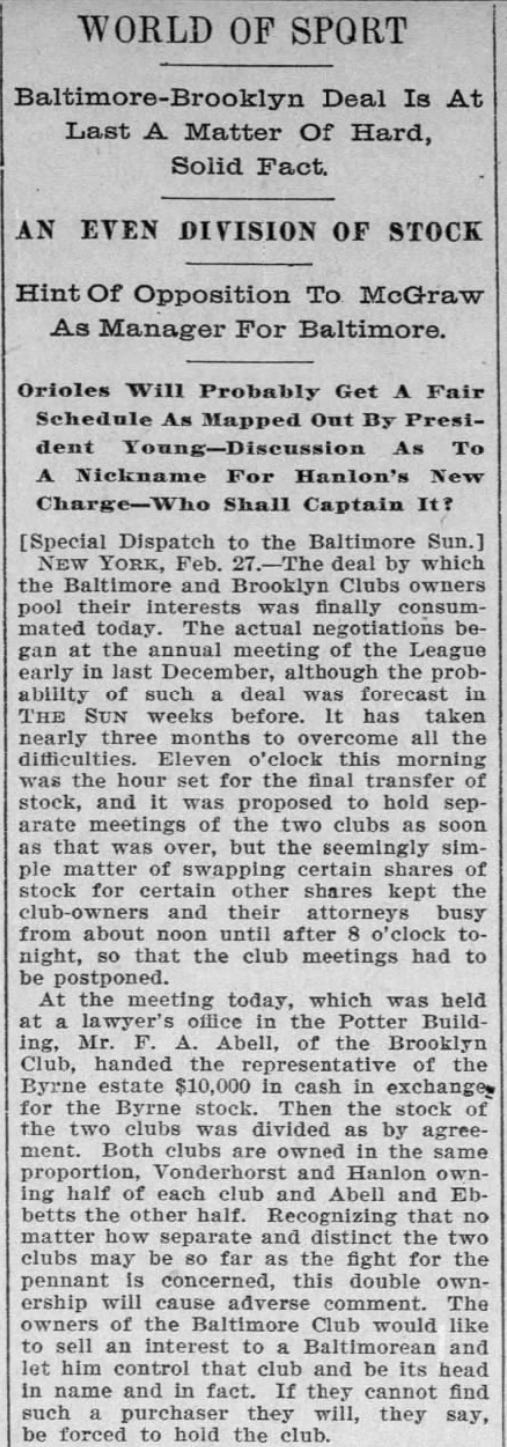
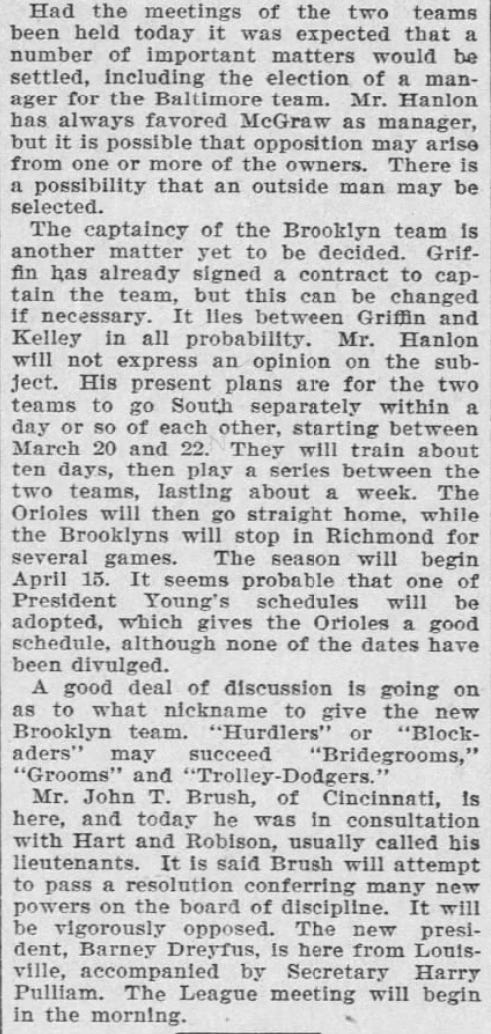
In the end, the team nickname was changed to the Superbas, though newspapers continued to refer to the team as the Bridegrooms, Trolley-Dodgers, and Dodgers over the coming years.
The local press did what it could to play up the new influx of talent:
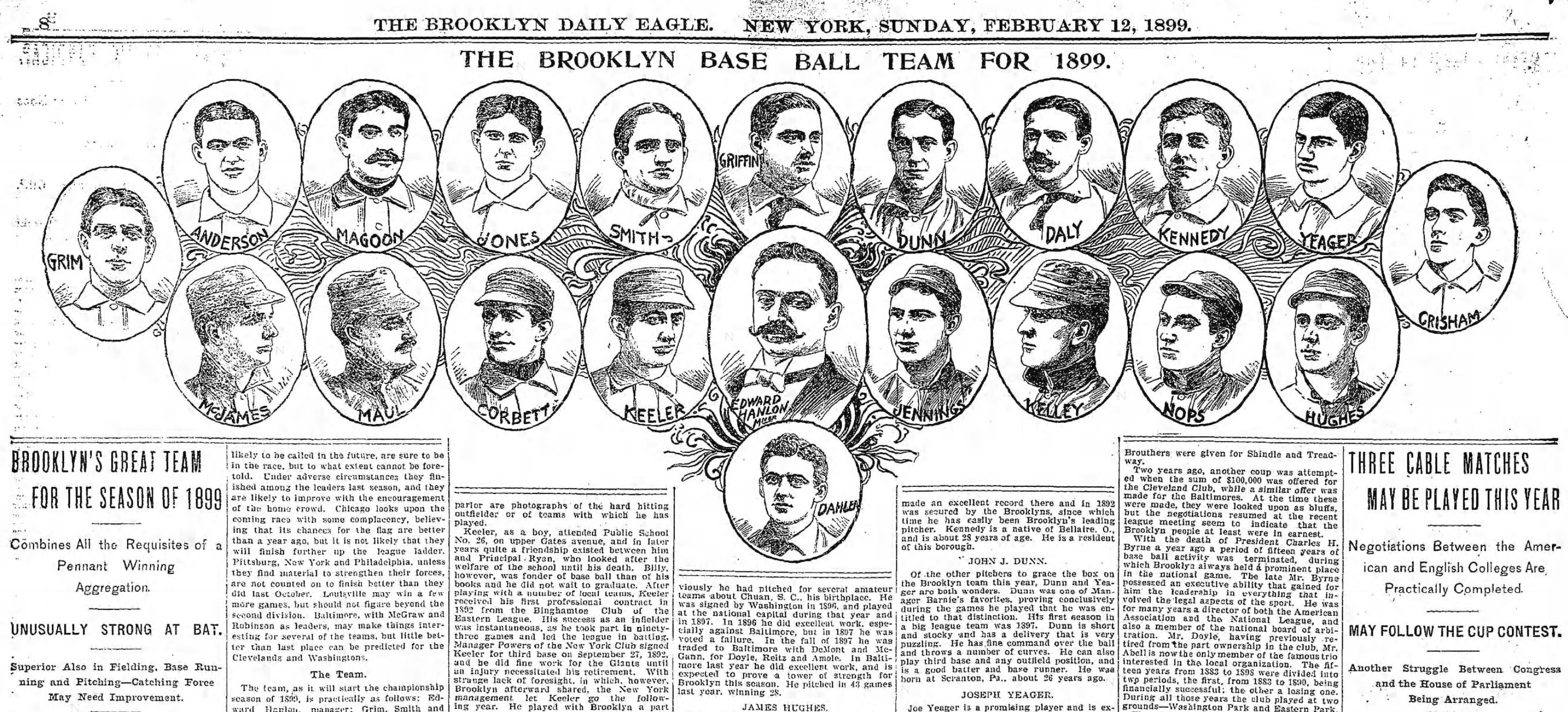
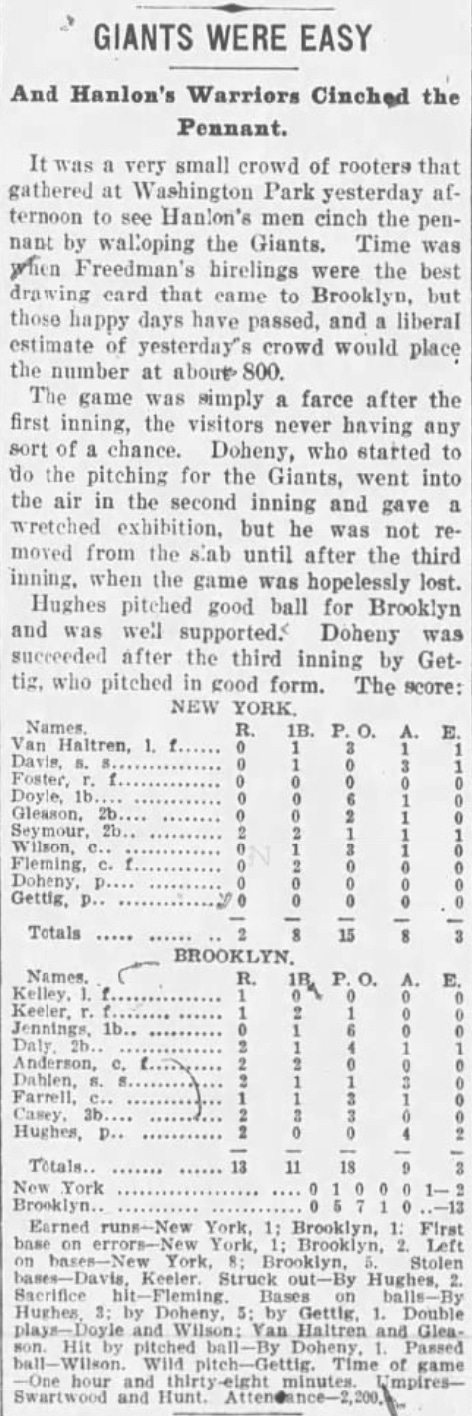
However, despite the best efforts of the newspapers, the truth is that the public was never really interested in this team. You can see that by the reported attendance on the day Brooklyn clinched the pennant against those hated Giants:
There are a few reasons why people stayed away in those days. For one thing, Washington Park was horrible. It was across the street from a bunch of factories, the air smelled horrible, and explosions from the factories would dump all sorts of soot into the sky. It got to the point where minor league players refused to go to the National League to play for Brooklyn, something you can clearly see in the case of Harry Pattee:
Second, of course, the Brooklyn team of 1899 and 1900 picked up all the bad habits of the old Orioles. Fans simply didn’t want to come watch baseball games marked by players breaking the rules when the sole umpire’s back was turned.
In fact, it got to the point where a credible rumor spread in June 1900 that the Brooklyn Superbas were moving to Washington D.C.:
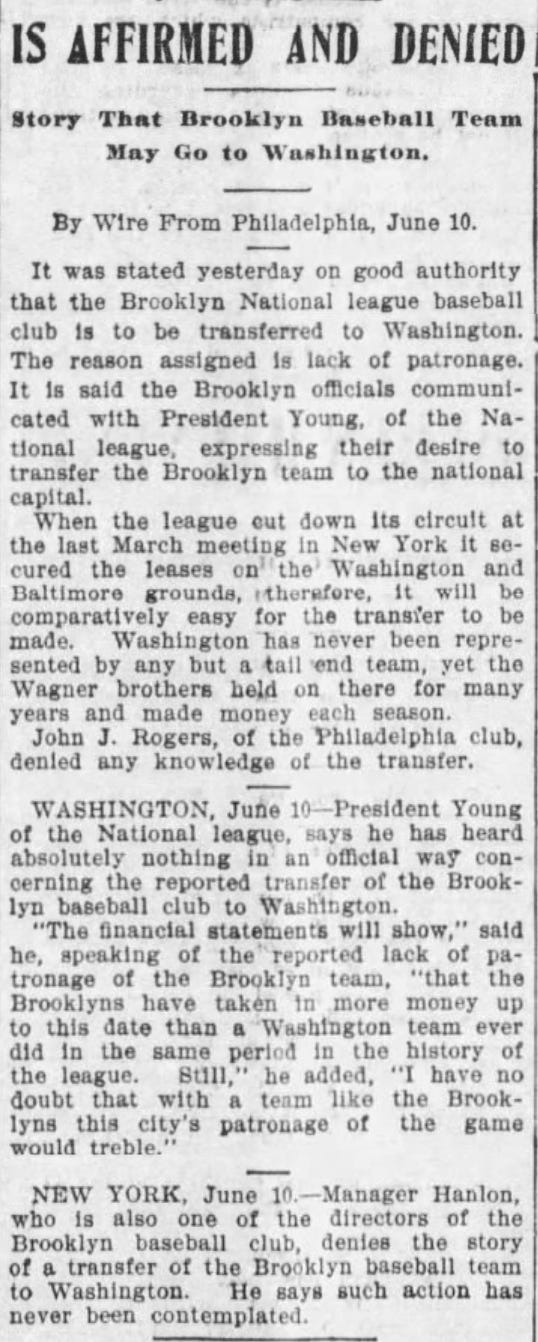
The defending World Champion Superbas were in first place at the time these rumors spread, and wound up winning the pennant again in 1900. But there’s a reason nobody in Brooklyn ever remembers the 1899 and 1900 National League champions.
Brooklyn’s next pennant didn’t come until 1916 - and, even then, the Dodgers didn’t exactly dominate the headlines.
On September 6, 1916, Brooklyn - then commonly known as the Robins - split a doubleheader with the New York Giants. This put Brooklyn in a virtual tie for first place with the Philadelphia Phillies:
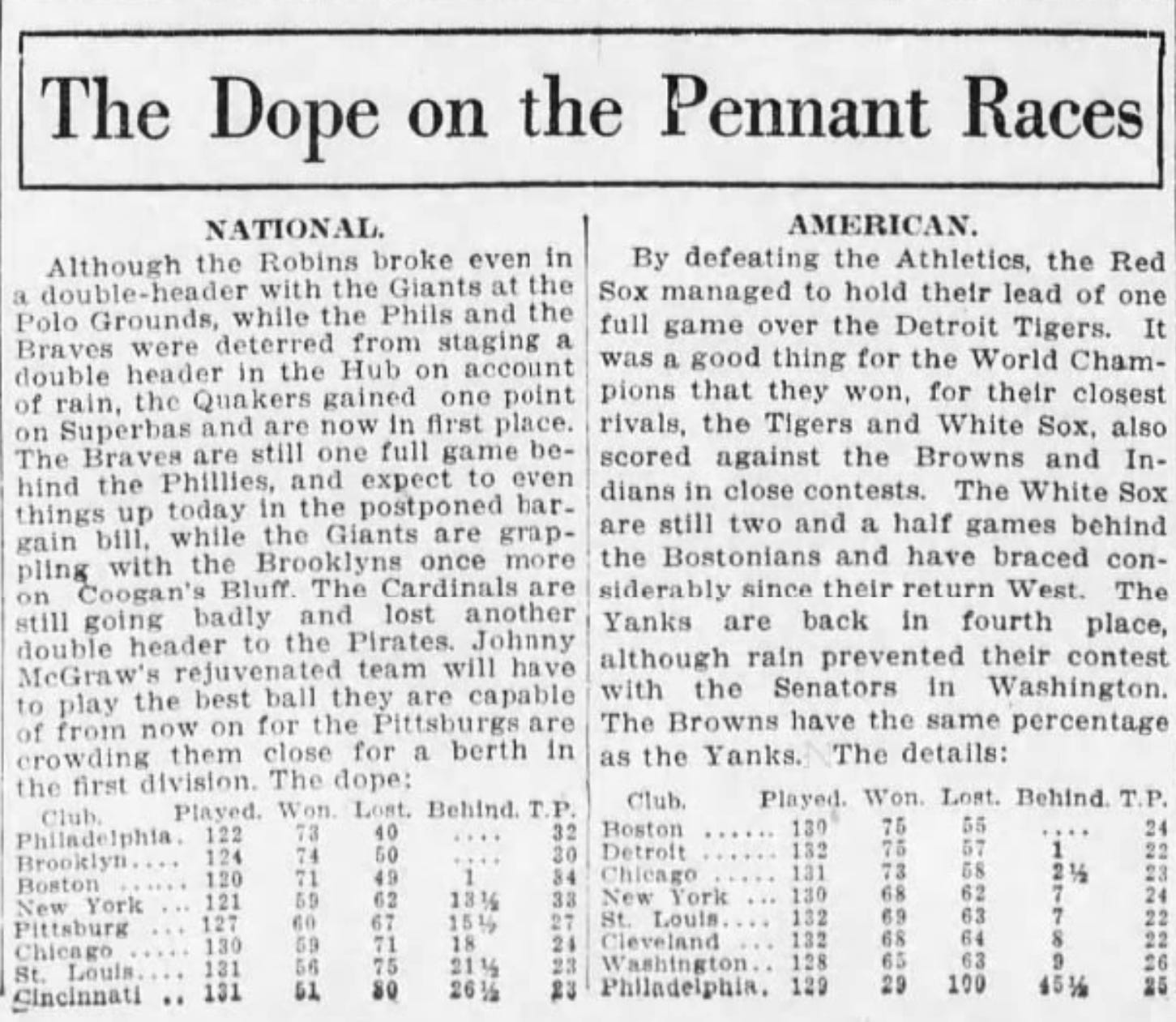
On Saturday, September 30, 1916, the standings looked like this:
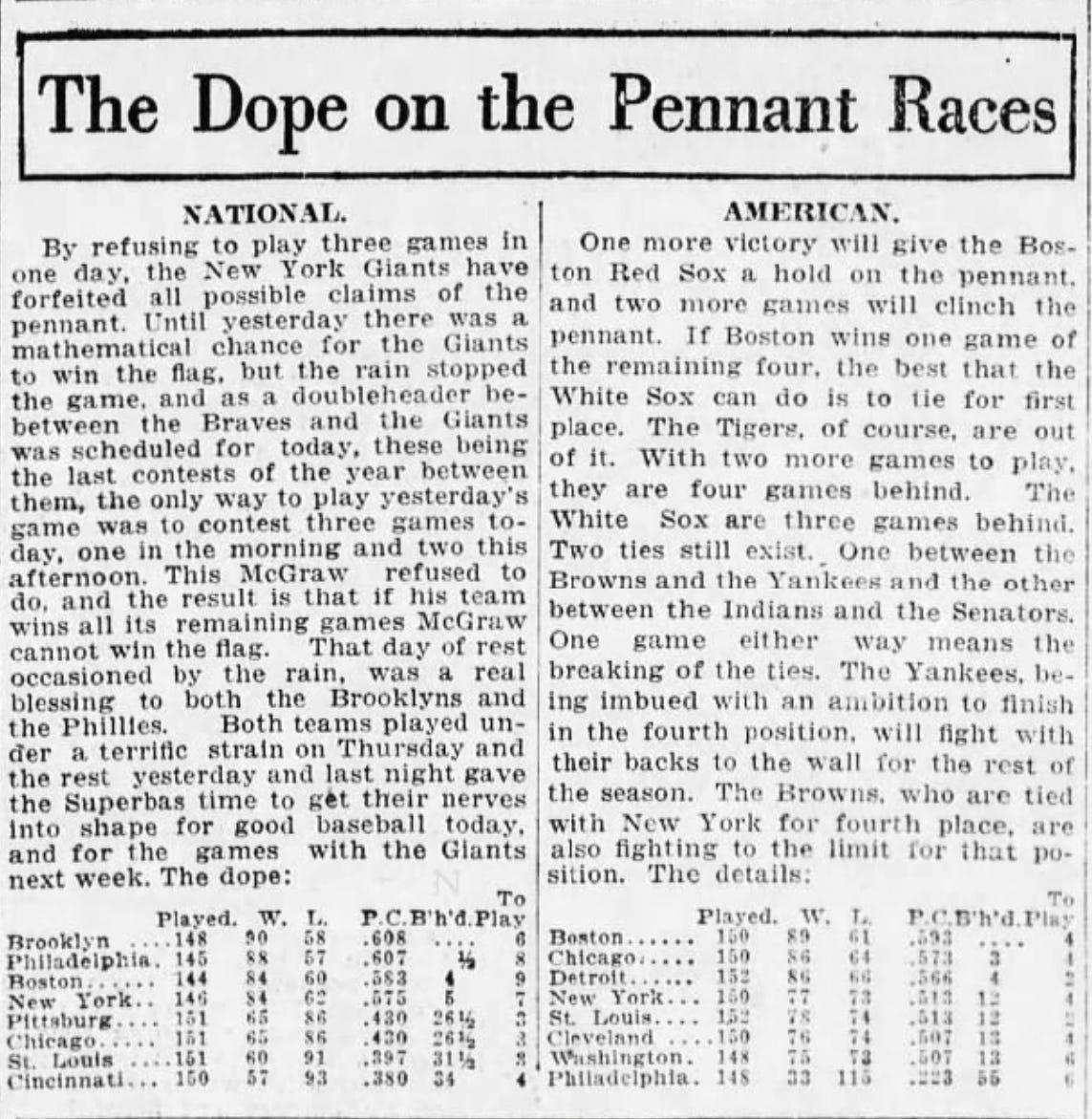
Incredibly, the New York Giants had managed to win 25 straight games - a streak that stretched out to 26 games when they beat Boston in the first game of the September 30 doubleheader. And yet they didn’t budge at all in the standings.
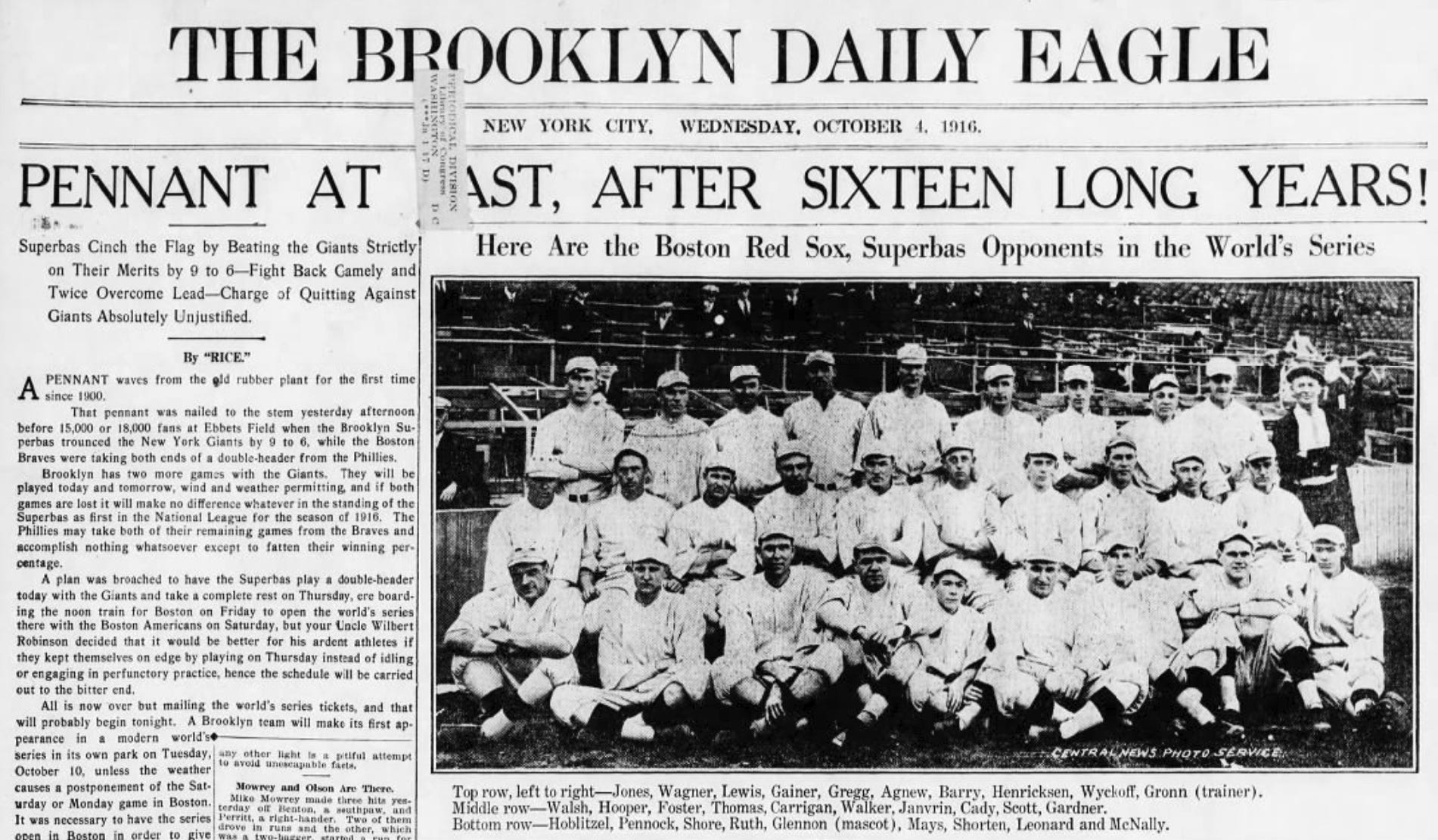
Brooklyn managed to win the penannt after beating the hated Giants twice in early October:
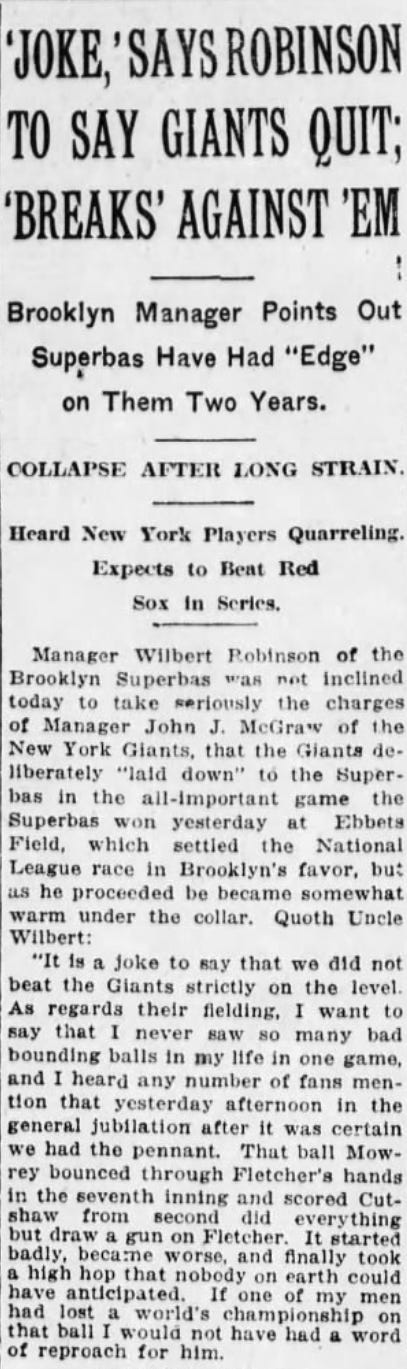
Even then, the feat was marred by rumors that the Giants had laid down in that final series:
Unfortunately for Brooklyn, they ran into a young pitcher named Ruth:
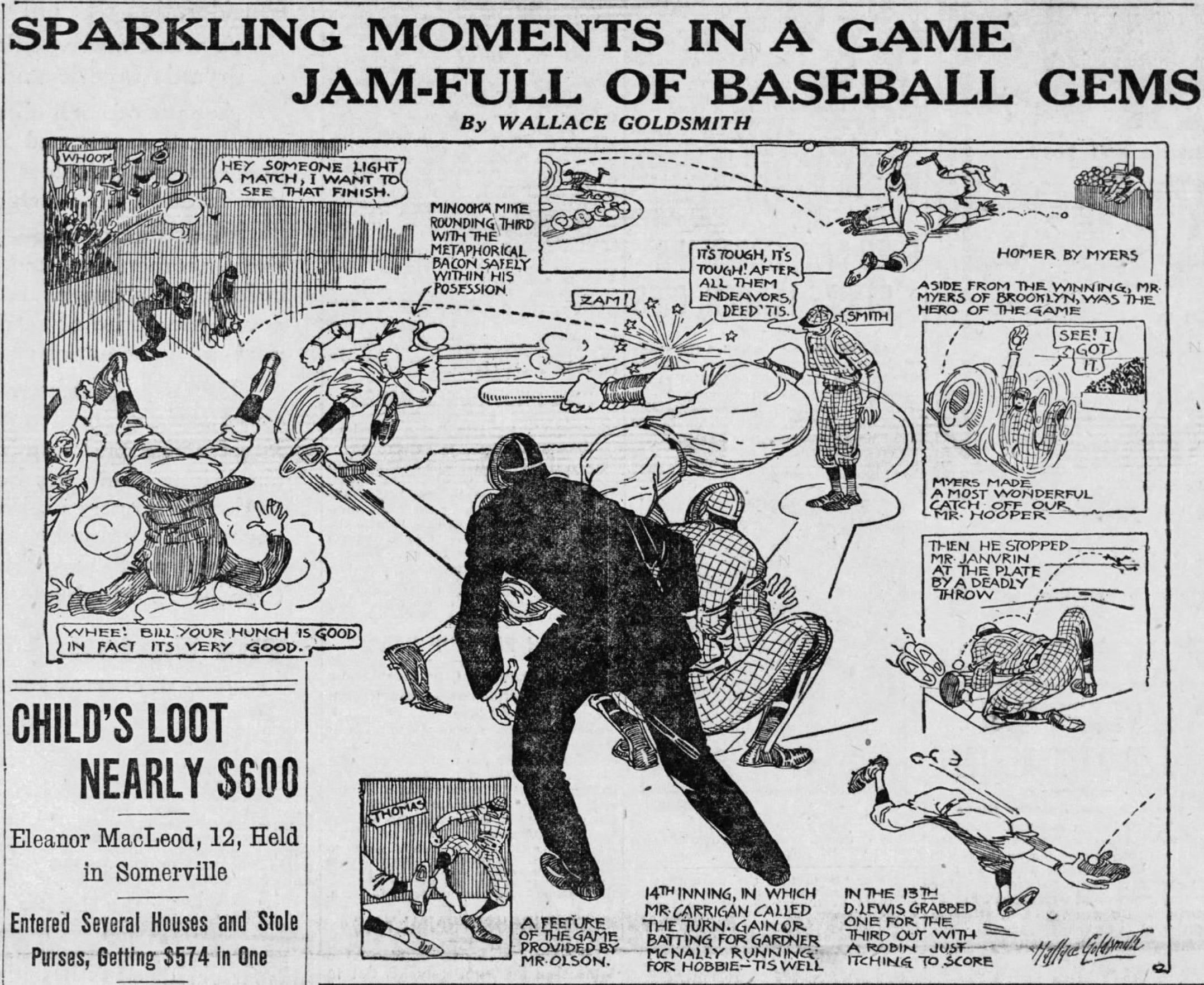
The Red Sox won the World Series easily, 4 games to 1.
Brooklyn was good through the end of the 1910s and into 1920. Its 1920 pennant, however, is chiefly remembered by one famous World Series play: the legendary unassisted triple play.
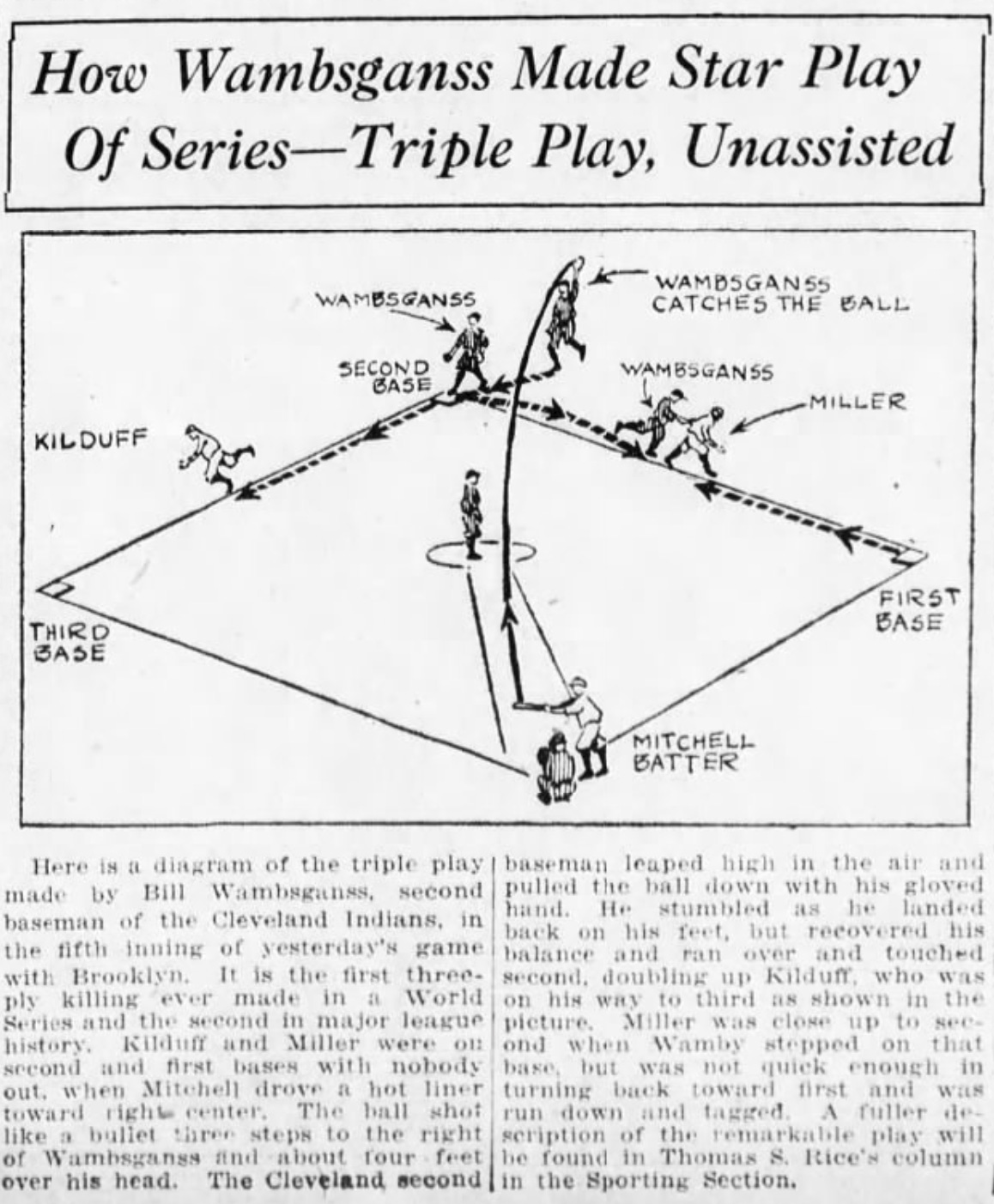
It was after that 1920 season that the old Robins slowly disappeared, only to be replaced by the Daffiness Boys.
Over the years, it seemed that Brooklyn did everything it could to find new and inventive ways to lose ballgames. And some of these plays remain famous to this day:
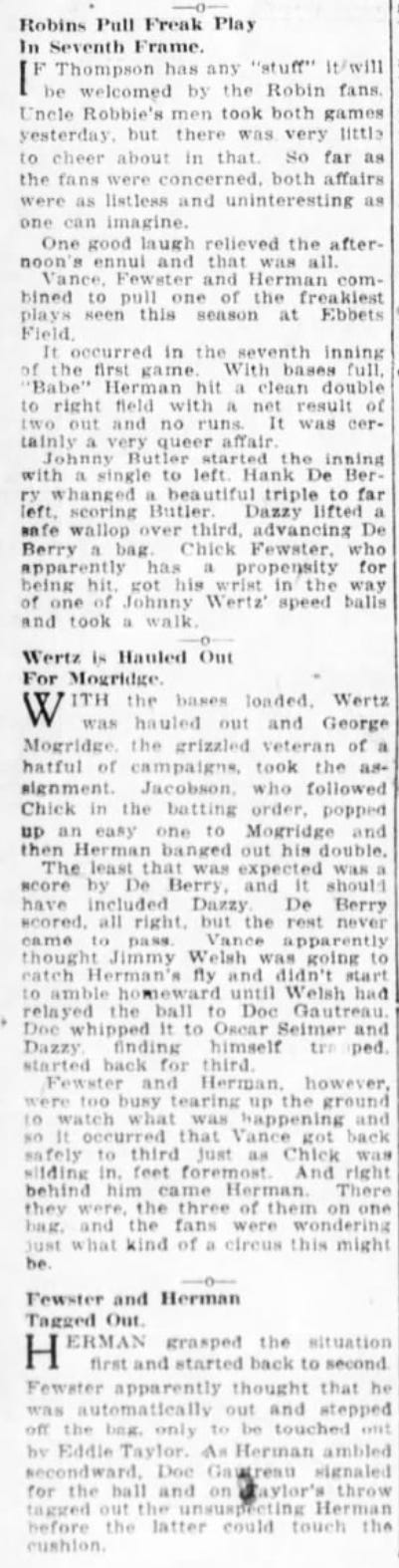
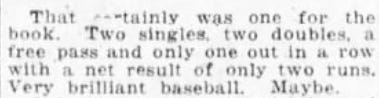
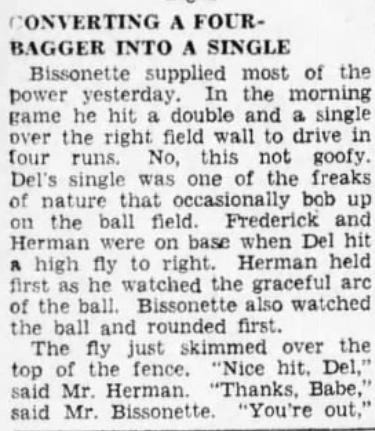
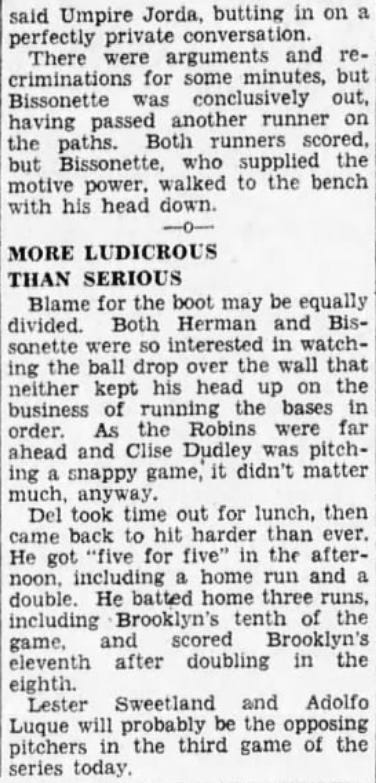
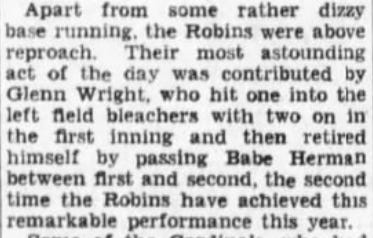
I believe Babe Herman is likely the only player in baseball history to be called out for being passed on the bases on home runs twice in the same season.
And then there was this bizarre play in 1931:
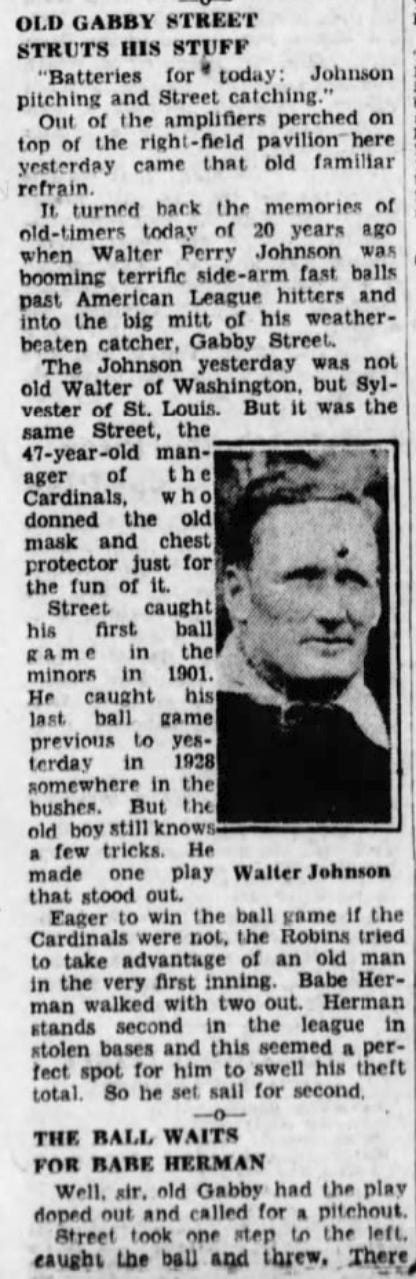
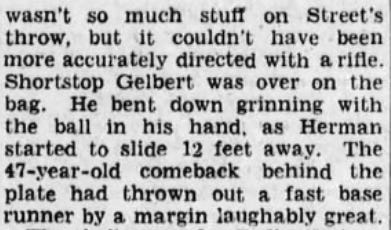
That typified the Brooklyn teams of the 1930s. They weren’t very good, sure, but you never knew what kind of bizarre thing they were going to do.
Things started to turn around for the Dodgers in 1939. After years of finishing in or near the second division, the Dodgers managed a third place finish that season. And it was that season that two famous Dodger sayings were born.
I don’t have a photo for the first one, unfortunately. There’s a report from Baseball Almanac that the famous phrase “Wait ‘Till Next Year” originated with a Willard Mullin cartoon on August 9, 1939. Sadly, I haven’t been able to find that cartoon anywhere, and the newspaper archives I have access to do not include The New York World-Telegram.
The second Dodger saying was “dem Bums,” an affectionate way to refer to the team. That one also seems to have come from a Mullin cartoon - likely this one:
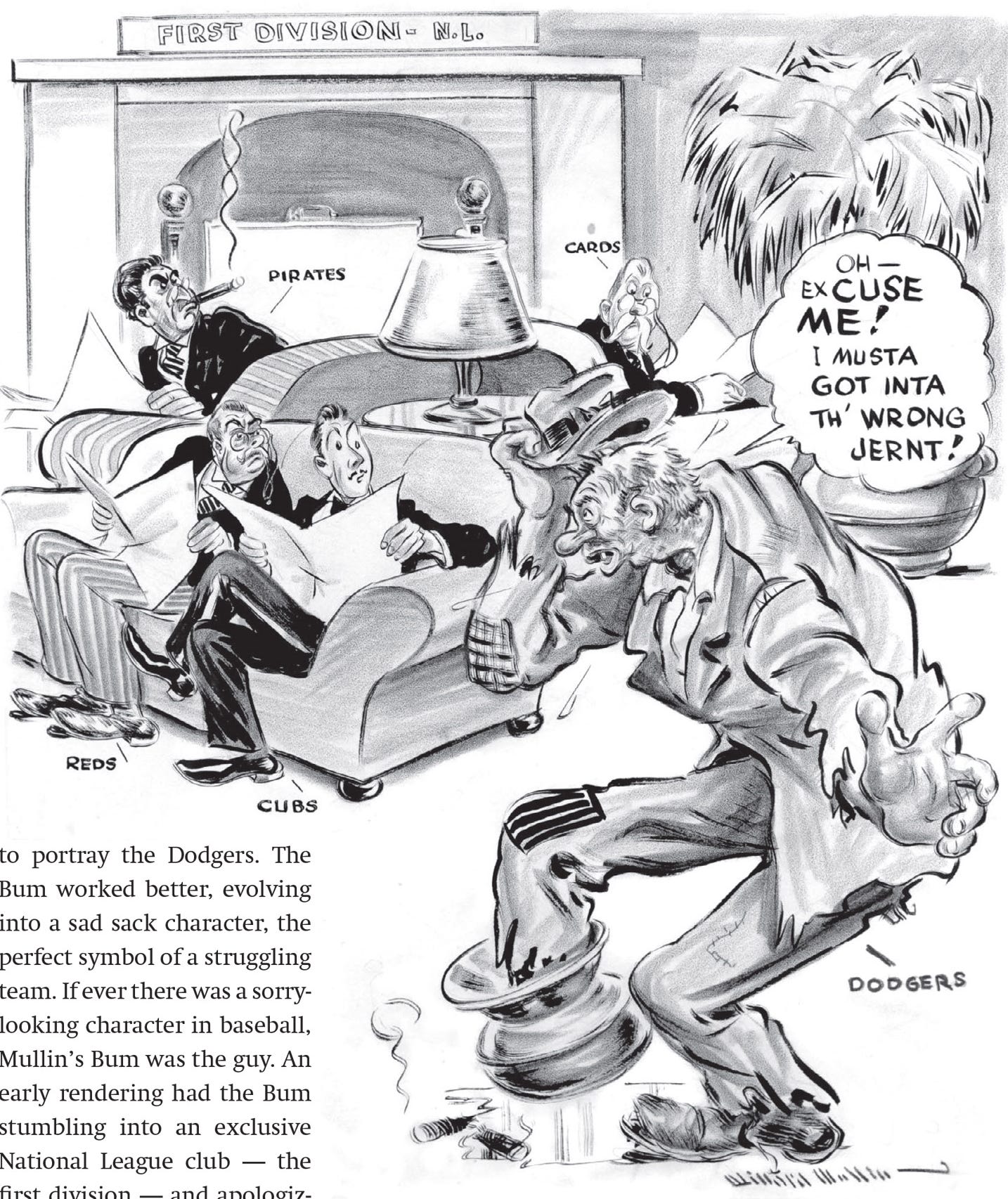
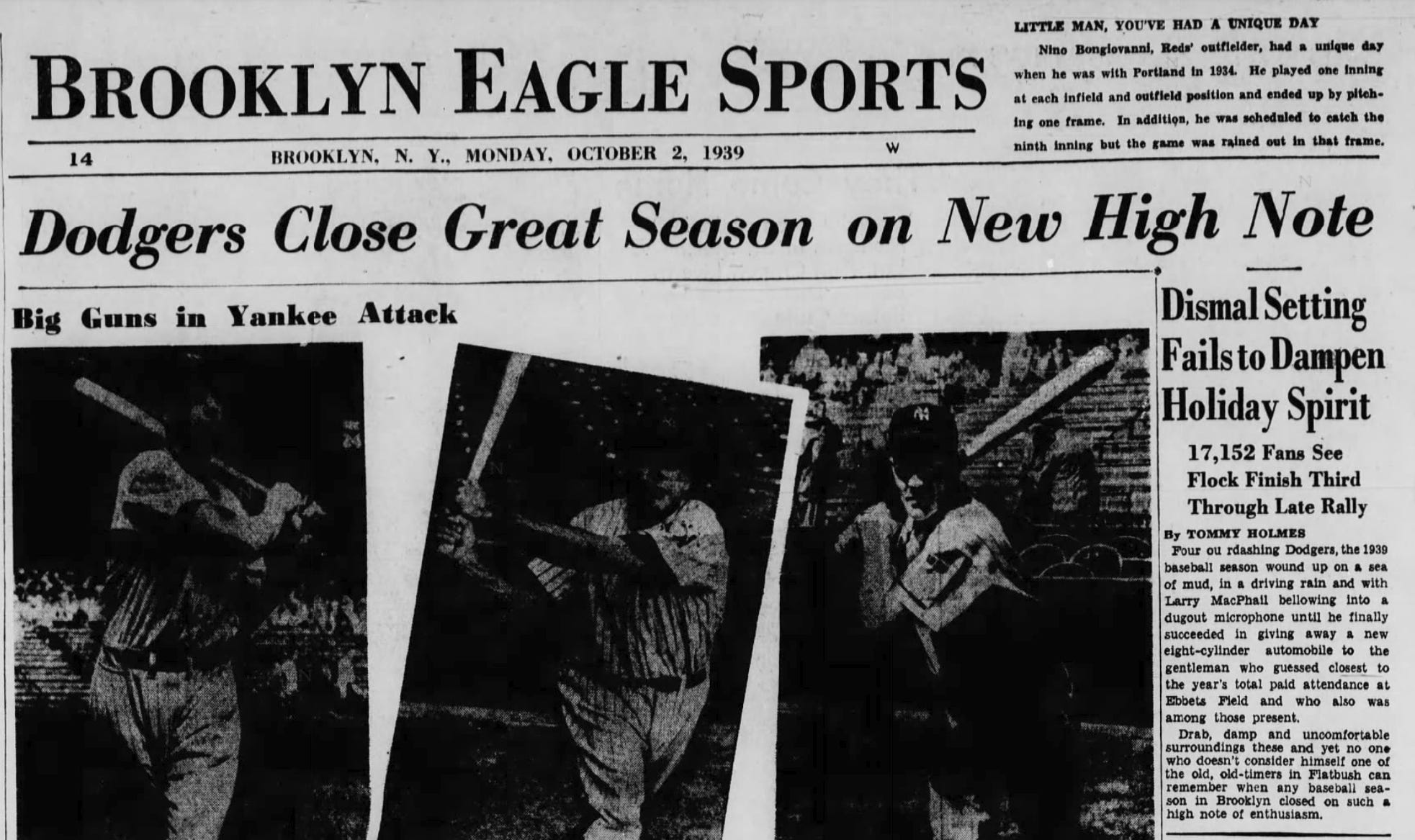
The truth is that the Dodgers only just managed to finish in third place:
And, as for the cries of “wait till next year,” there is some evidence that it might have been in use even before 1939. Here’s a random example from Maine:
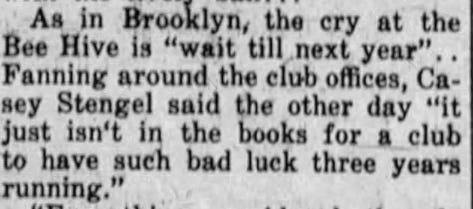
In fact, that October issue of The Brooklyn Eagle insinuates that the phrase had been around for quite some time:
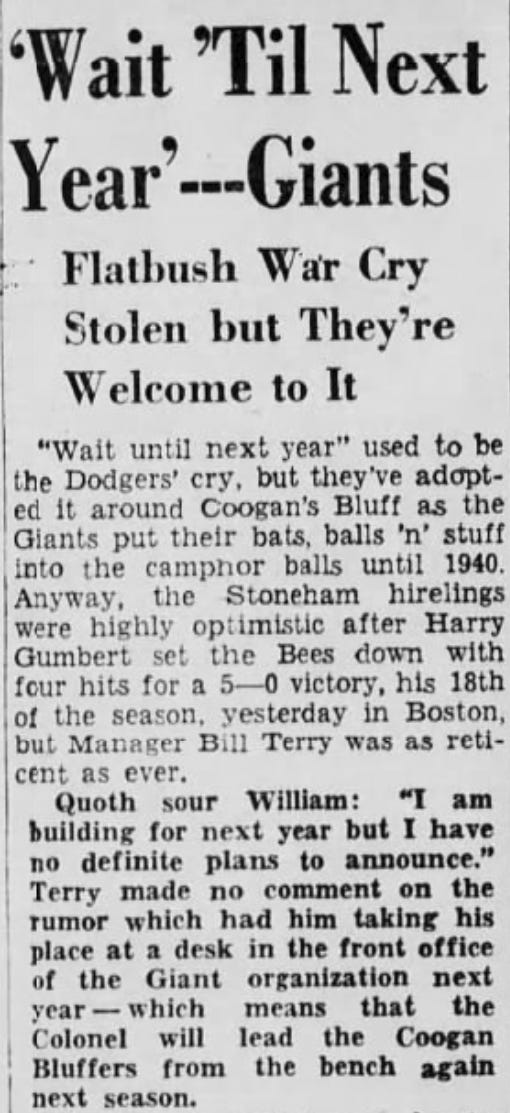
Regardless, the rallying cry was destined to be associated with the Dodgers.
Brooklyn was close in 1940, but a pair of long losing streaks near the end of the season knocked the team out of the race:
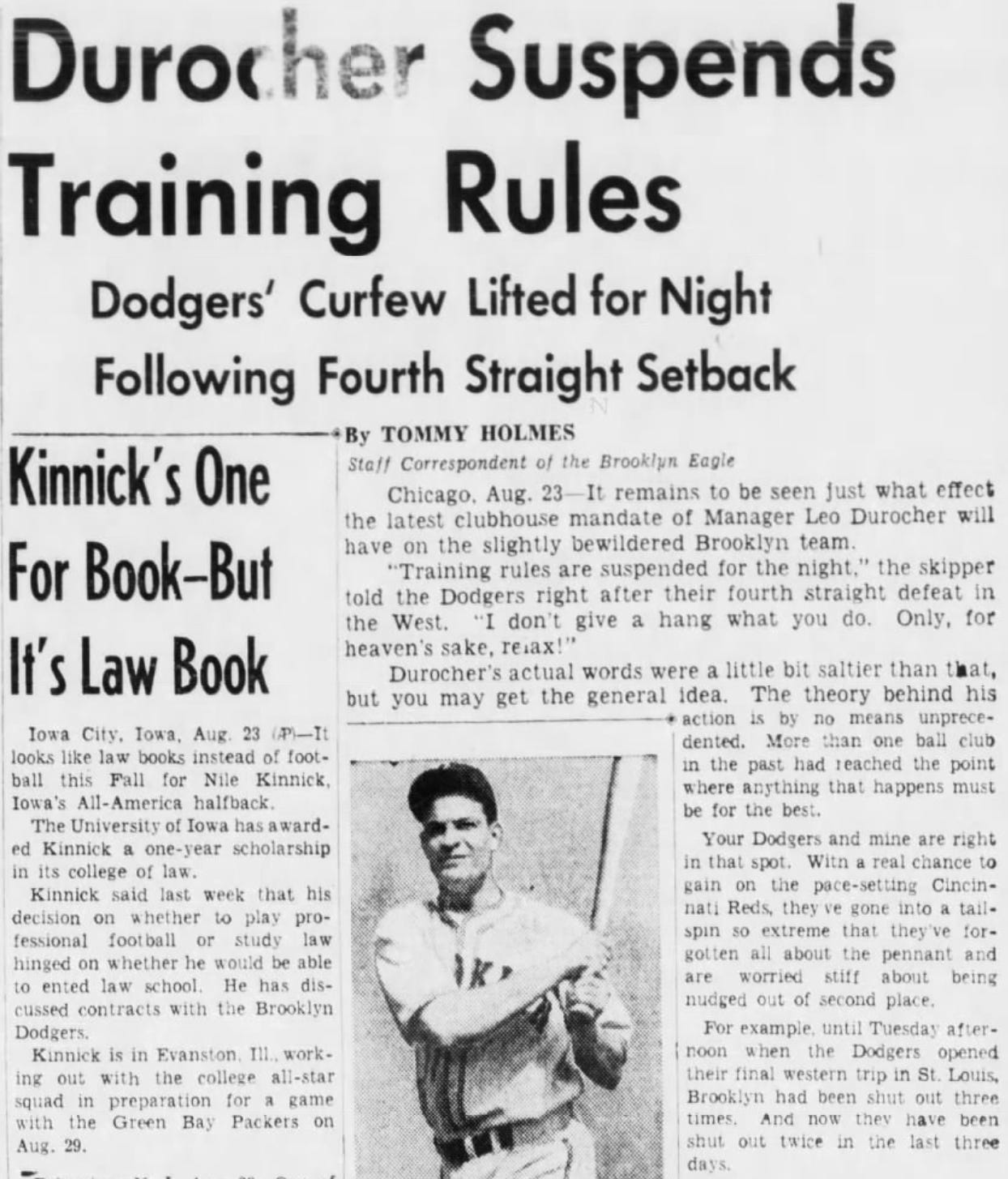
You probably know the rest of the story from here.
The Dodgers won 100 games in 1941, hitting the century mark for the first time since that tainted 1899 season. But then this happened:
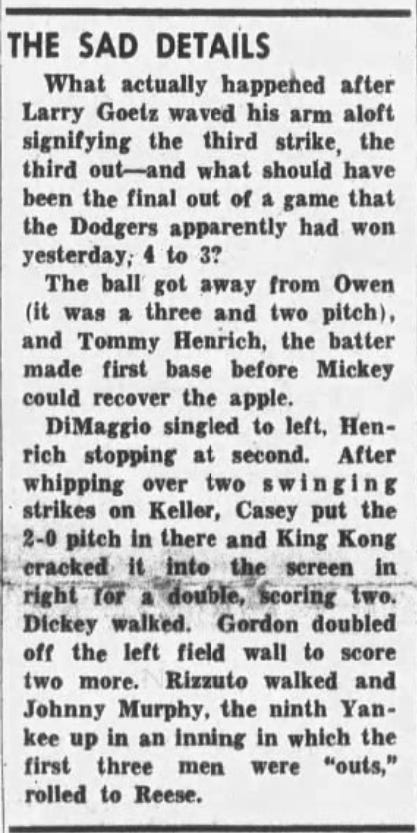
It was really after that 1941 World Series that the Dodgers fully adopted their rallying cry:
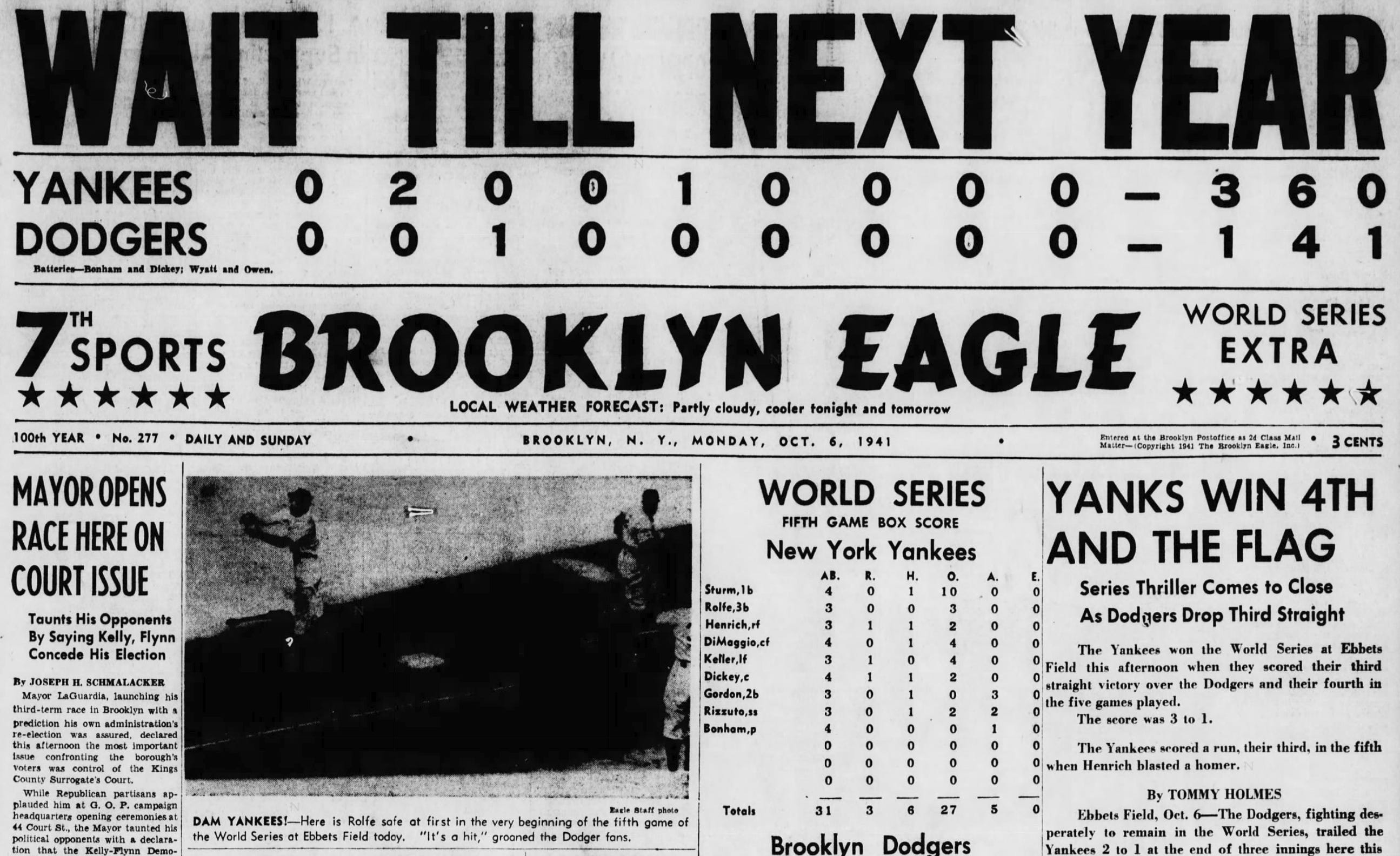
Brooklyn won a whopping 104 games in 1942, but still couldn’t overtake St. Louis:
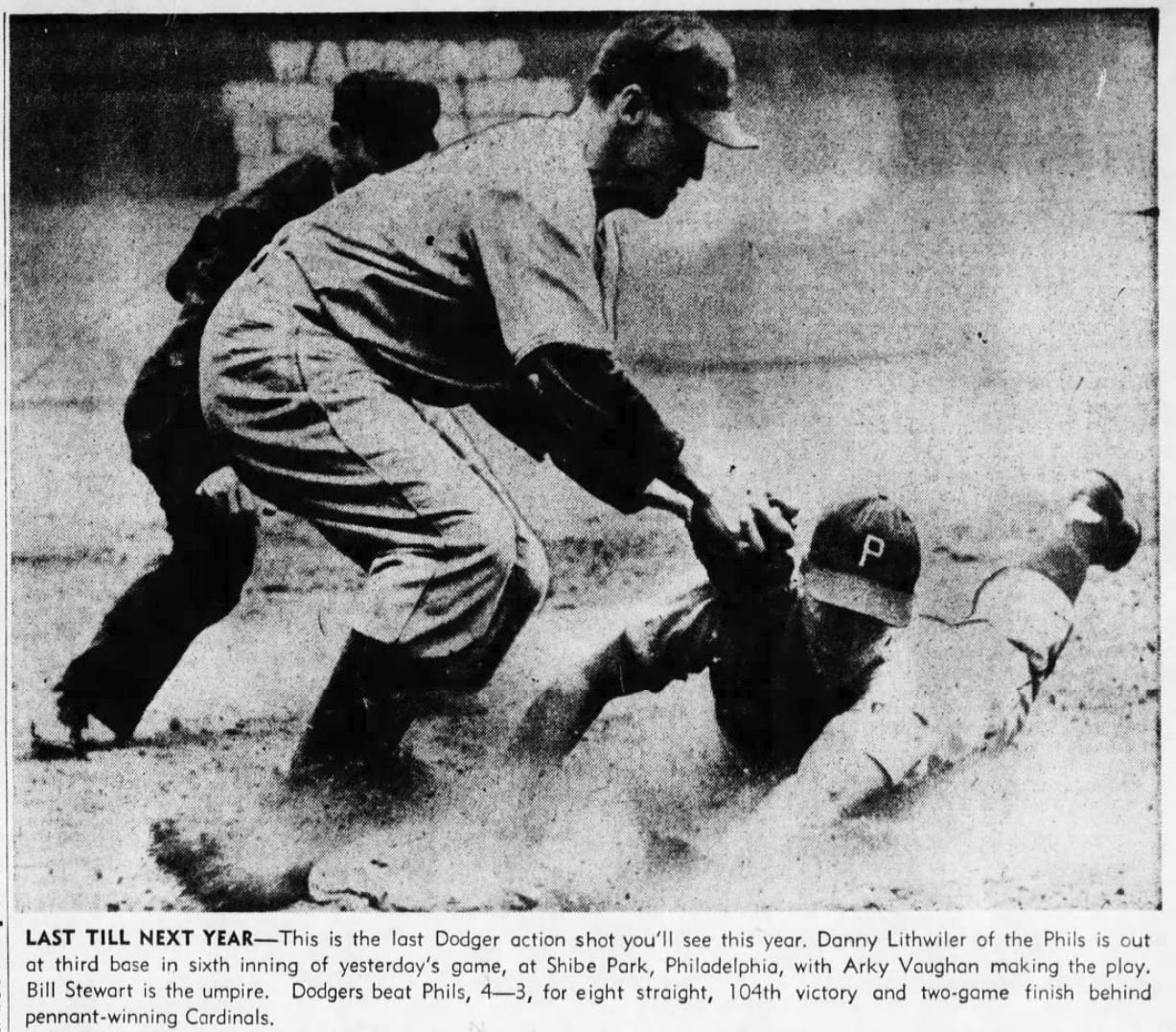
In 1946, once the war was over, the Dodgers and Cardinals ended the season tied:
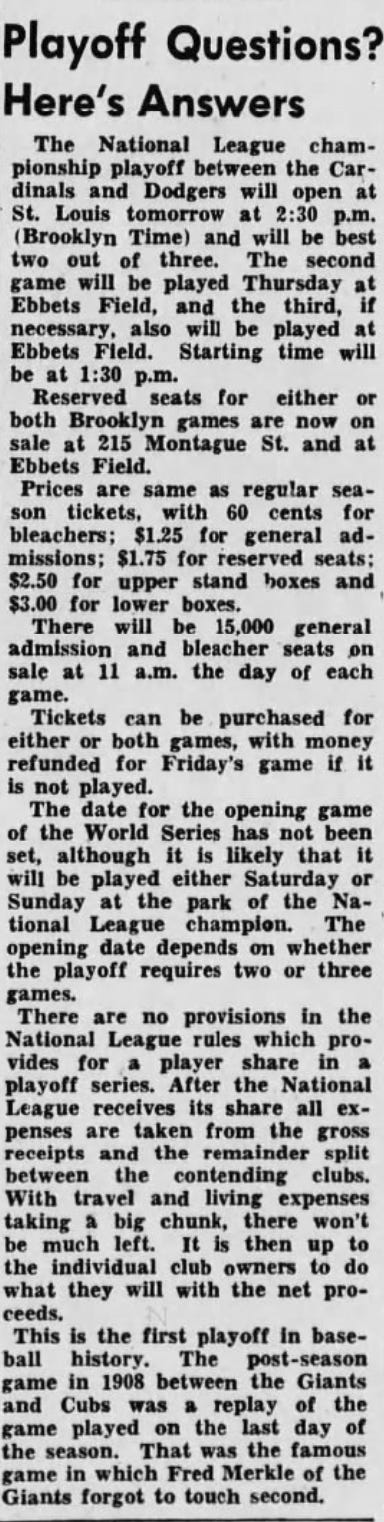
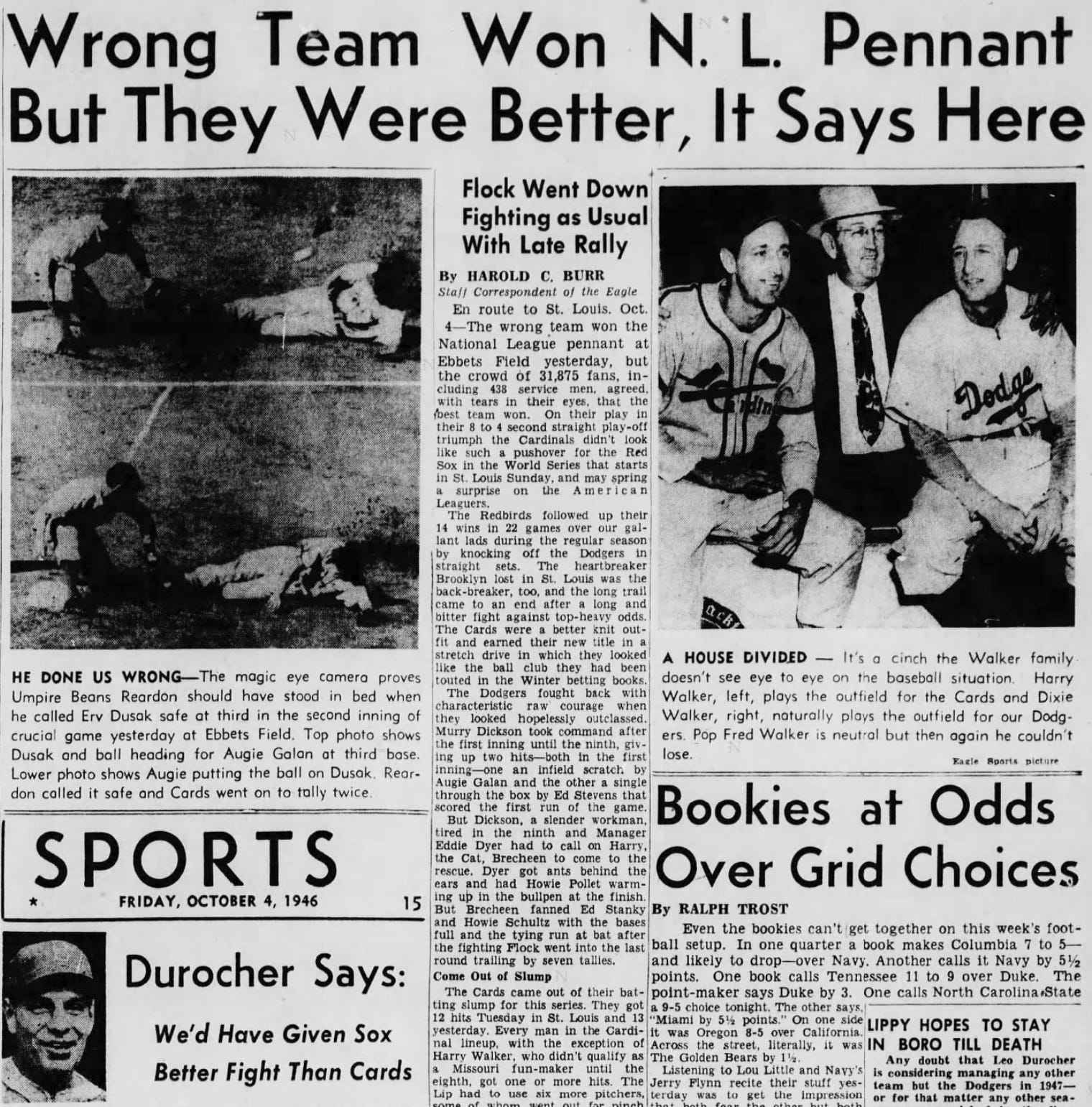
But they lost two straight games to give the pennant to St. Louis:
Brooklyn, now featuring Jackie Robinson, not only won the pennant in 1947, but also won one of the most amazing games in World Series history:
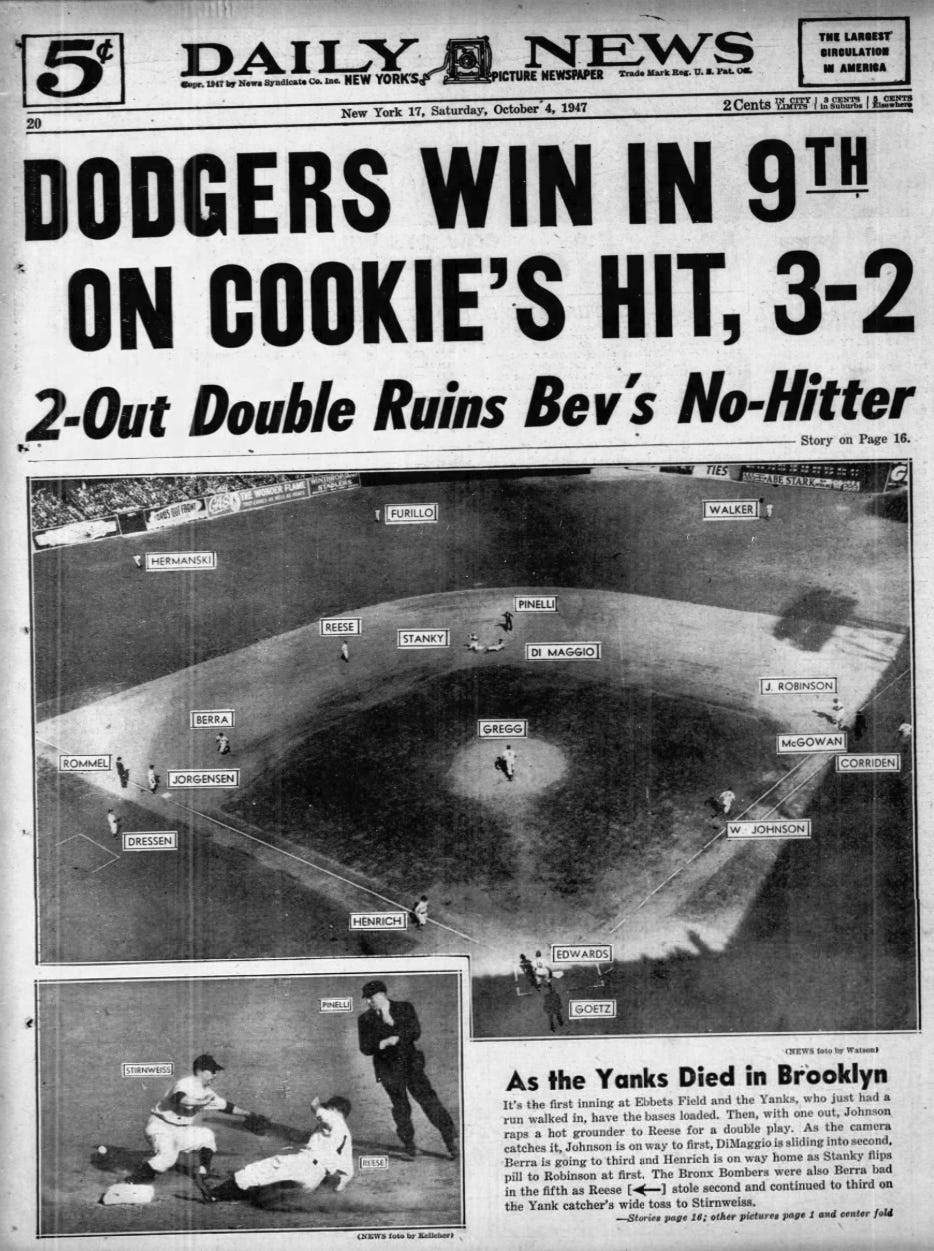
But, in the end, the Yankees won that World Series as well.
And I could go on - probably for hours.
Brooklyn finished 3rd in 1948, but rebounded to finish 1st in 1949. They then lost the World Series in 5 games.
The Dodgers looked better than ever in 1950, but stumbled that summer. Brooklyn made a valliant effort to come back, and was within a game of the Phillies on the last day of the season. That was a home game against the Phillies, and the Dodgers had ace Don Newcombe on the mound.
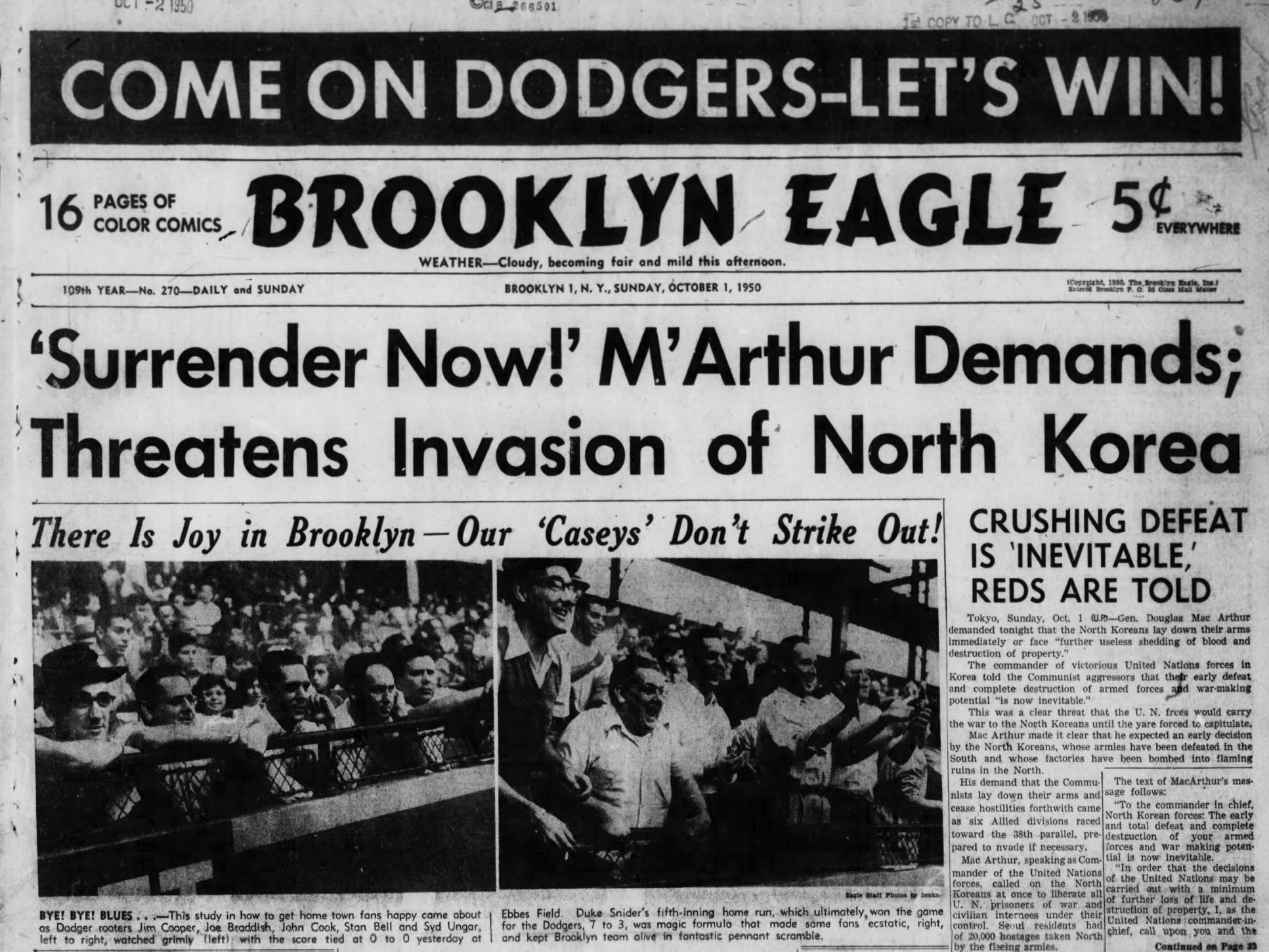
The Phillies won, 4-1, and “next year” had to wait.
Brooklyn’s 13 game lead late in 1951 was erased. In 1952, the Dodgers went back home for the final two games with a 3 to 2 Series lead; they managed to lose.
The 1953 Dodgers went 105-49, a team considered by many to be one of the best National League teams of all time. They lost to the Yankees in 6 games.
Brooklyn came within a game and a half of the New York Giants in late August 1954:
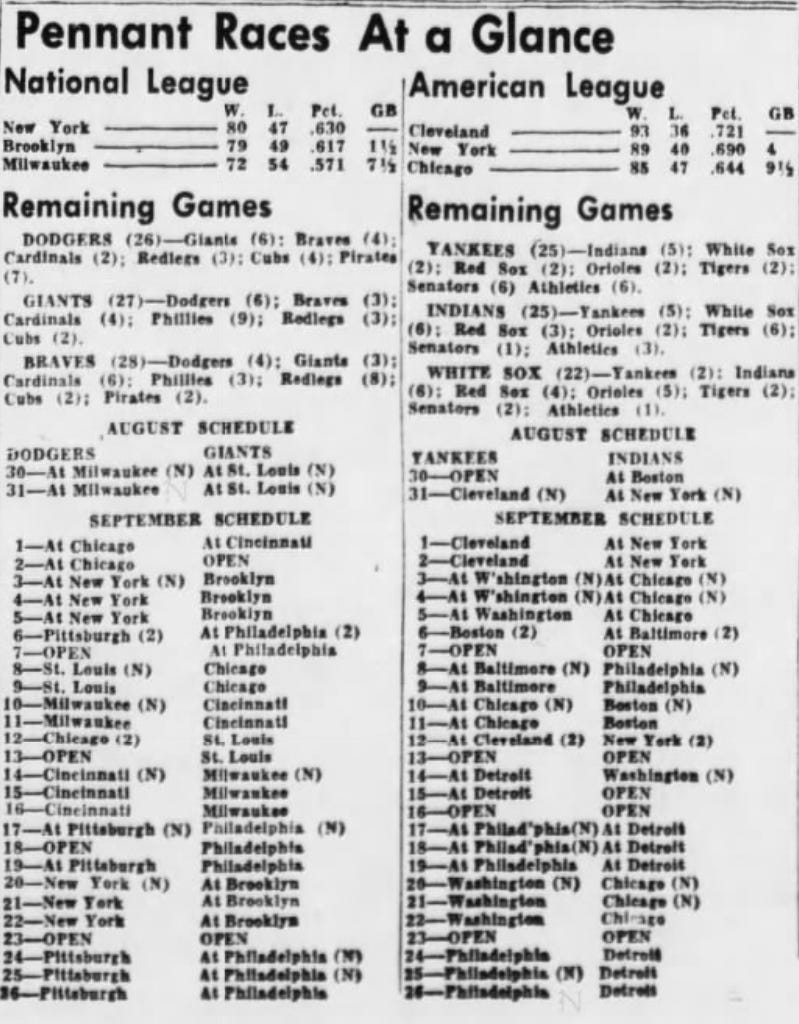
Brooklyn proceeded to go 13-13 the rest of the way, finishing 5 games out of first place. And only a four game winning streak at the tail end of the season prevented it from looking worse than that.
And now it was 1955. The Dodgers had clinched the National League pennant earlier than any other team in history.
But the team was growing older, and was looking unstable. Don Newcombe was out of the World Series by this point due to shoulder issues. Jackie Robinson had ankle issues and stayed out of Game 7.
The Dodgers had all sorts of promising young talent, though the kids weren’t quite ready for the big stage yet. Young phenom Karl Spooner was rocked for 5 runs in a third of an inning in Game 6.
Brooklyn had basically given up any concept of a pitching rotation by this point. Newcombe was out and wasn’t coming back. Billy Loes had lasted only 3 2/3 innings before coming out of Game 2. The normally reliable Carl Erskine had managed only 3 innings in Game 4, and, since there were no rest days for travel, was a major risk if Alston tried to pitch him on 2 days rest.
I honestly don’t think Alston had planned to start youngsters Roger Craig and Karl Spooner in consecutive games. Alston’s problem was that he apparently didn’t have much faith left in Loes, and that Newcome was injured.
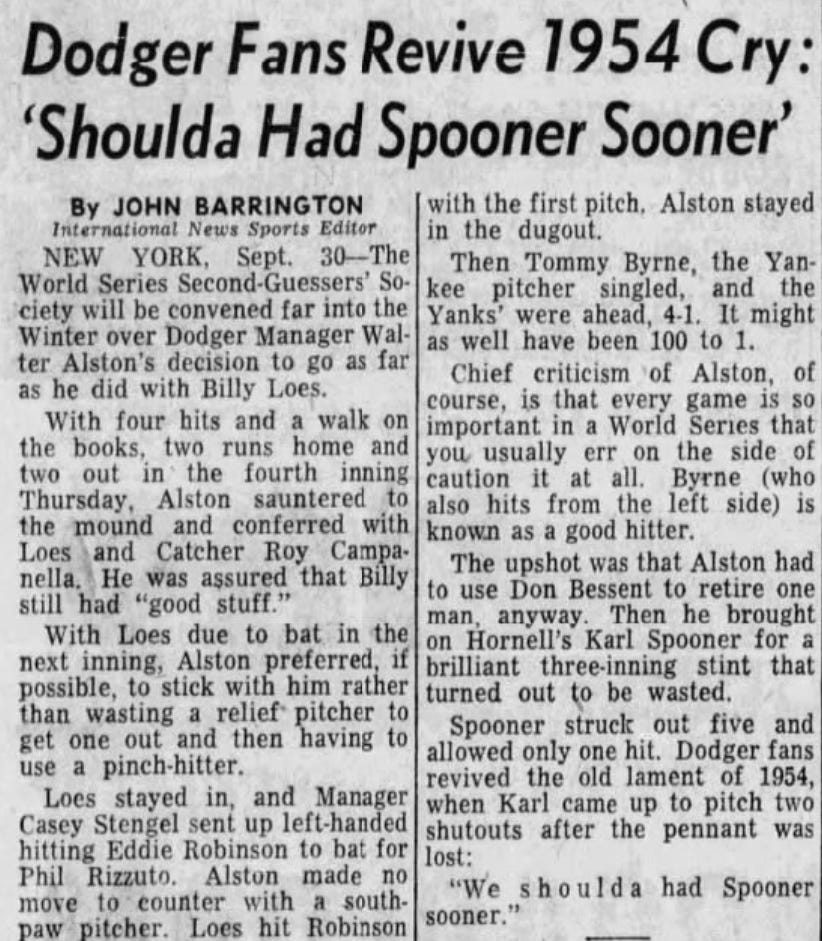
Alston was also receiving criticism in the media for sticking with Loes as long as he did in Game 2 and not going straight to Karl Spooner:
For whatever reason, Alston decided to go with 22 year old Johnny Podres in Game 7. And Game 7 just so happened to be held on Podres’ birthday.
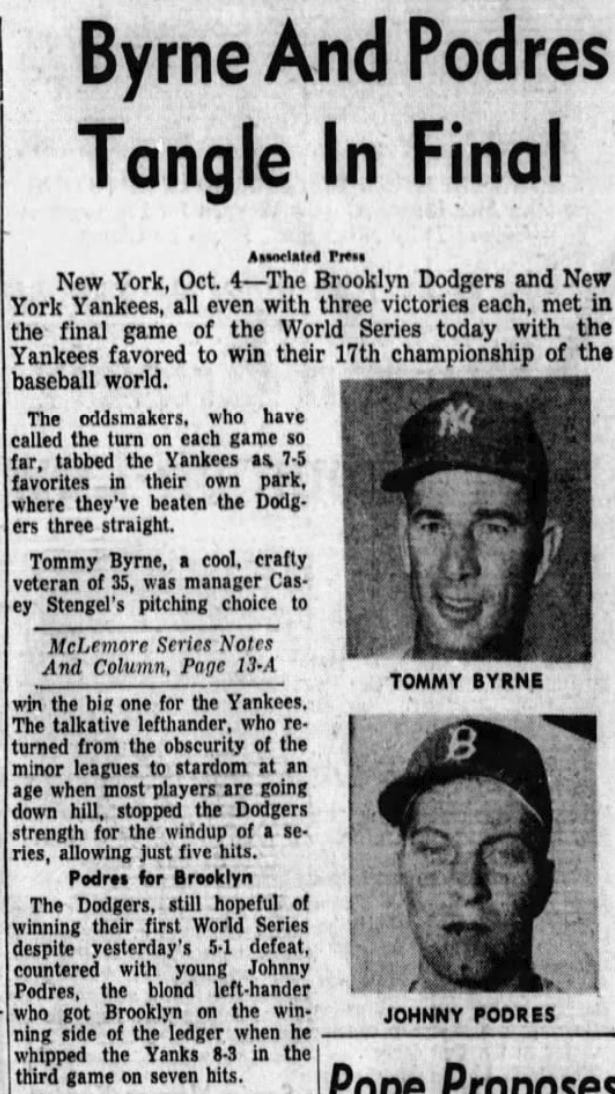
Game 7 was famous for a few key plays.
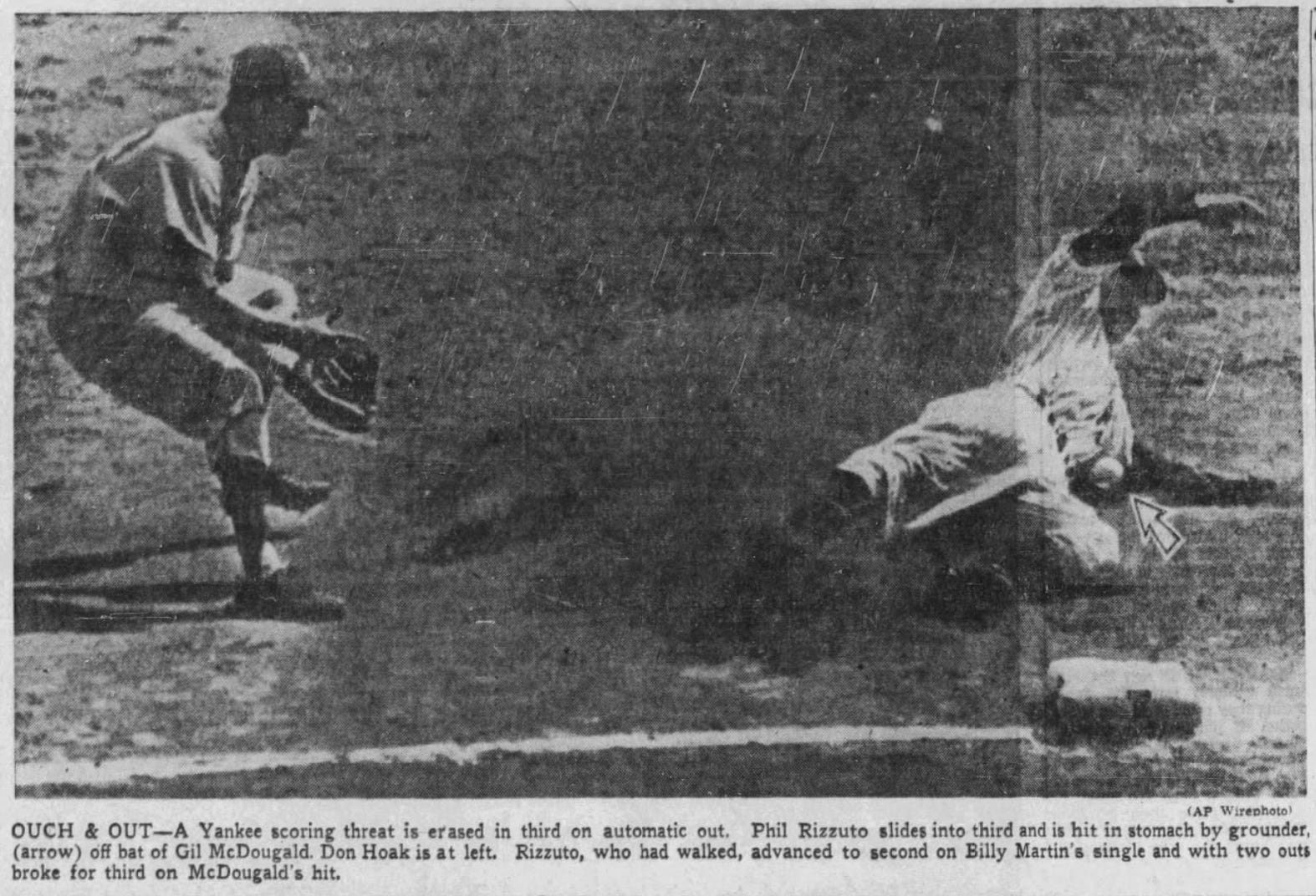
In the bottom of the 3rd inning, the Yankees had runners on first and second with two men out. Stengel called for a hit and run, and Phil Rizzuto and Billy Martin were off with the pitch. Gil McDougald hit a ground ball that wound up striking Rizzuto for the third out:
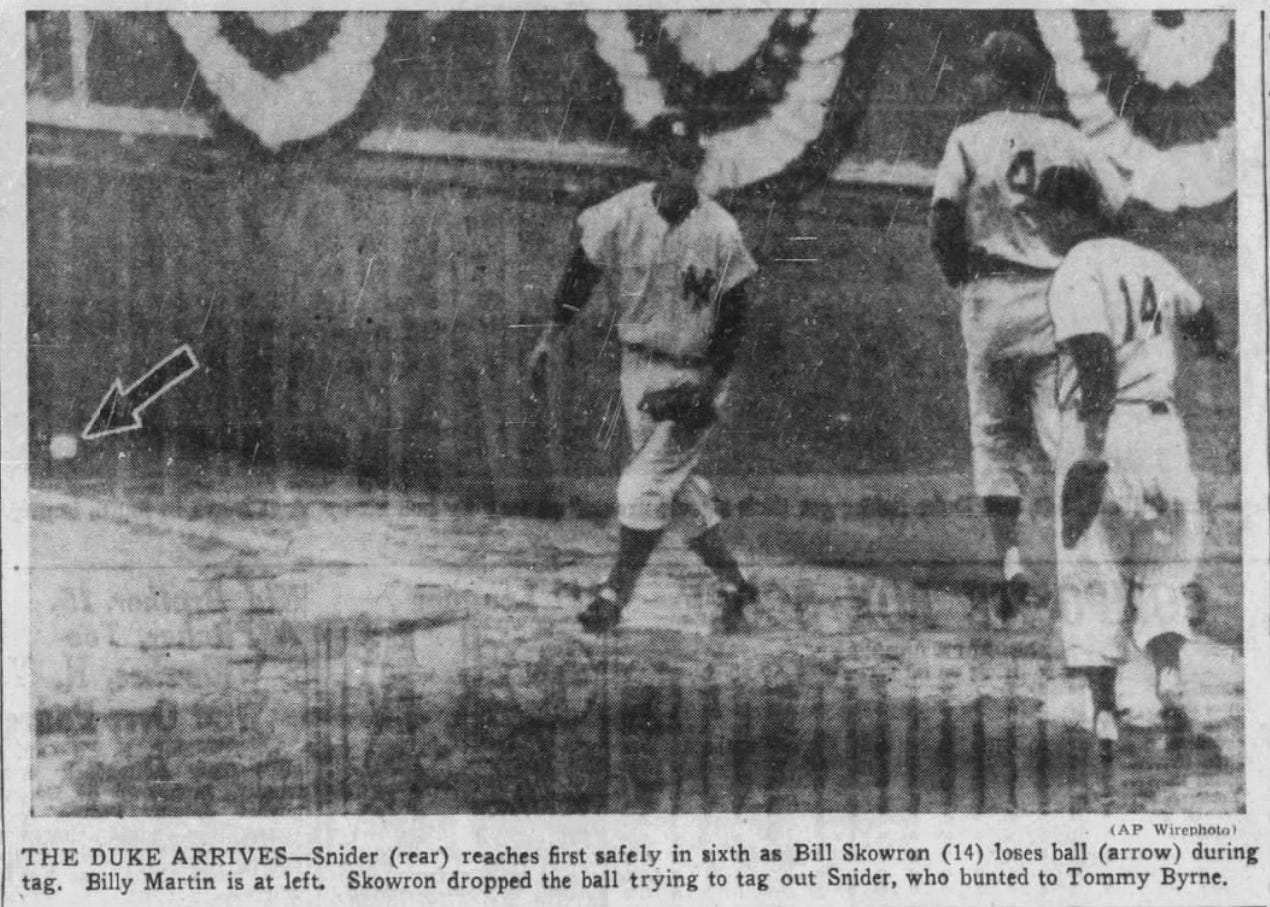
After Brooklyn managed to score a run in the top of the 4th inning, the Dodgers were looking to add another. In the top of the 6th, Pee Wee Reese reached with a leadoff single. And Duke Snider, who had hit 4 home runs so far in the World Series and was easily the most fearsome batter in Brooklyn’s lineup, surprised everybody by bunting.
The throw beat Snider to first, but he seems to have knocked the ball loose from Moose Skowron’s glove:
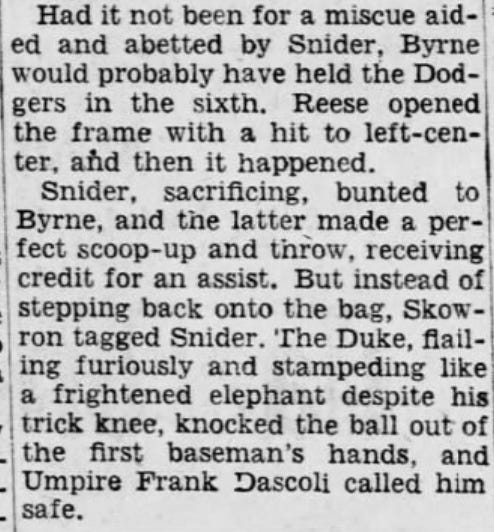
Skowron’s mistake was trying to tag Duke instead of stepping on the bag:
National League MVP Roy Campanella also bunted, which was another huge surprise. The Yankees fielded this one properly, but the runners advanced.
Carl Furillo was walked intentionally. And then Gil Hodges hit a sacrifice fly to give Brooklyn an unusual run. And it was one of those strange innings: 3 sacrifices, 1 run scored.
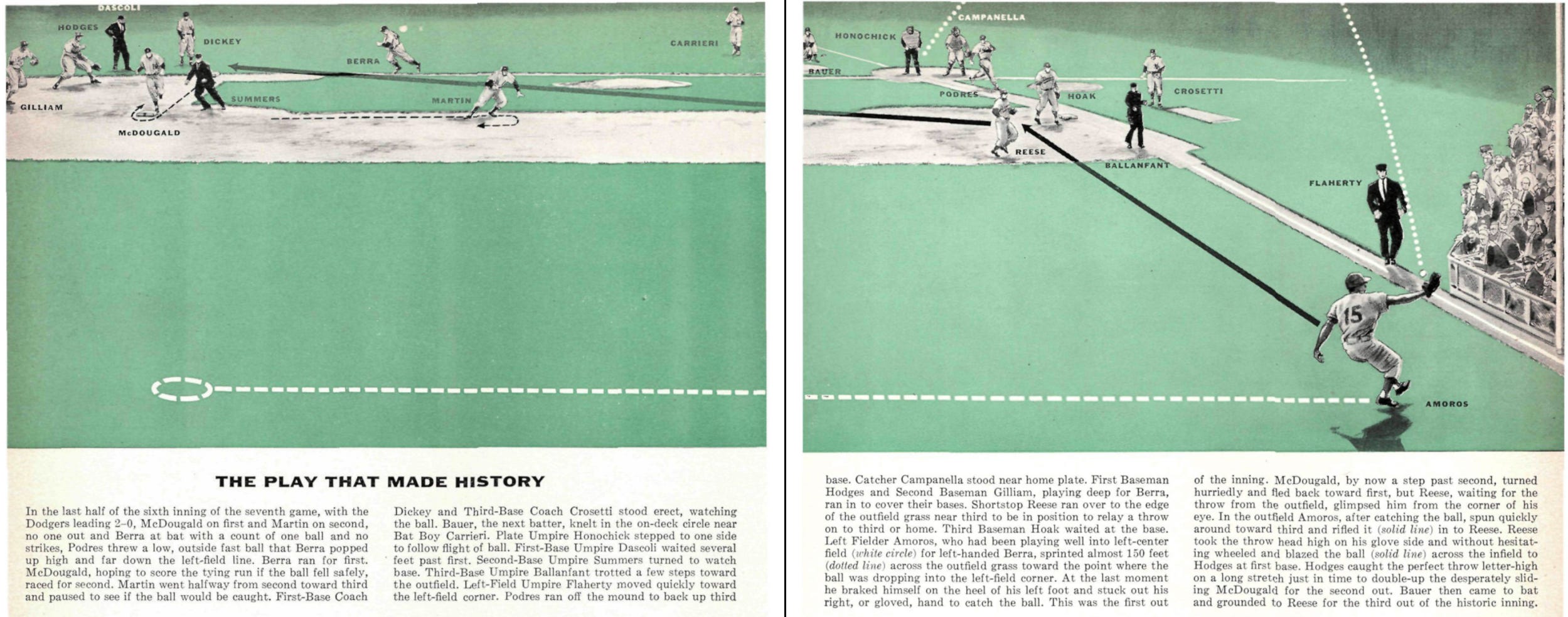
The most famous play them came in the bottom of the 6th inning. With Billy Martin on second and Gil McDougald on first and nobody out, Yogi Berra hit a fly ball down the left field line that came within two feet of being a home run. Sandy Amoros made a catch that used to be one of the most famous catches in World Series history:
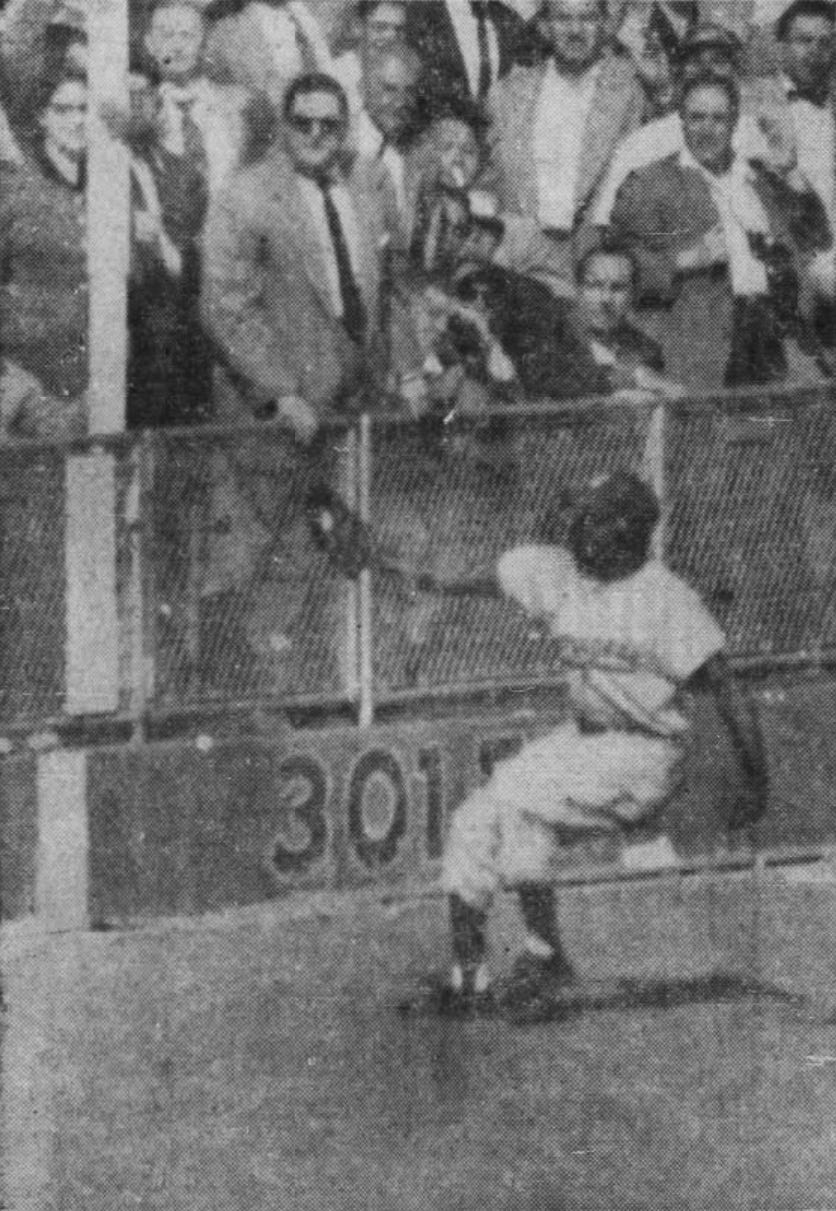
Amoros hit Pee Wee Reese with the cutoff throw, and the Dodgers were able to double Gil McDougald off first base - a play that must have reminded older Dodger fans of Babe Herman’s base running adventures.
The Yankees pieced together two singles in the bottom of the 8th with one man out. However, Berra popped out to shallow right field, and Podres got Hank Bauer out on a strikeout.
And, in the bottom of the 9th, the Yankees went down in order.
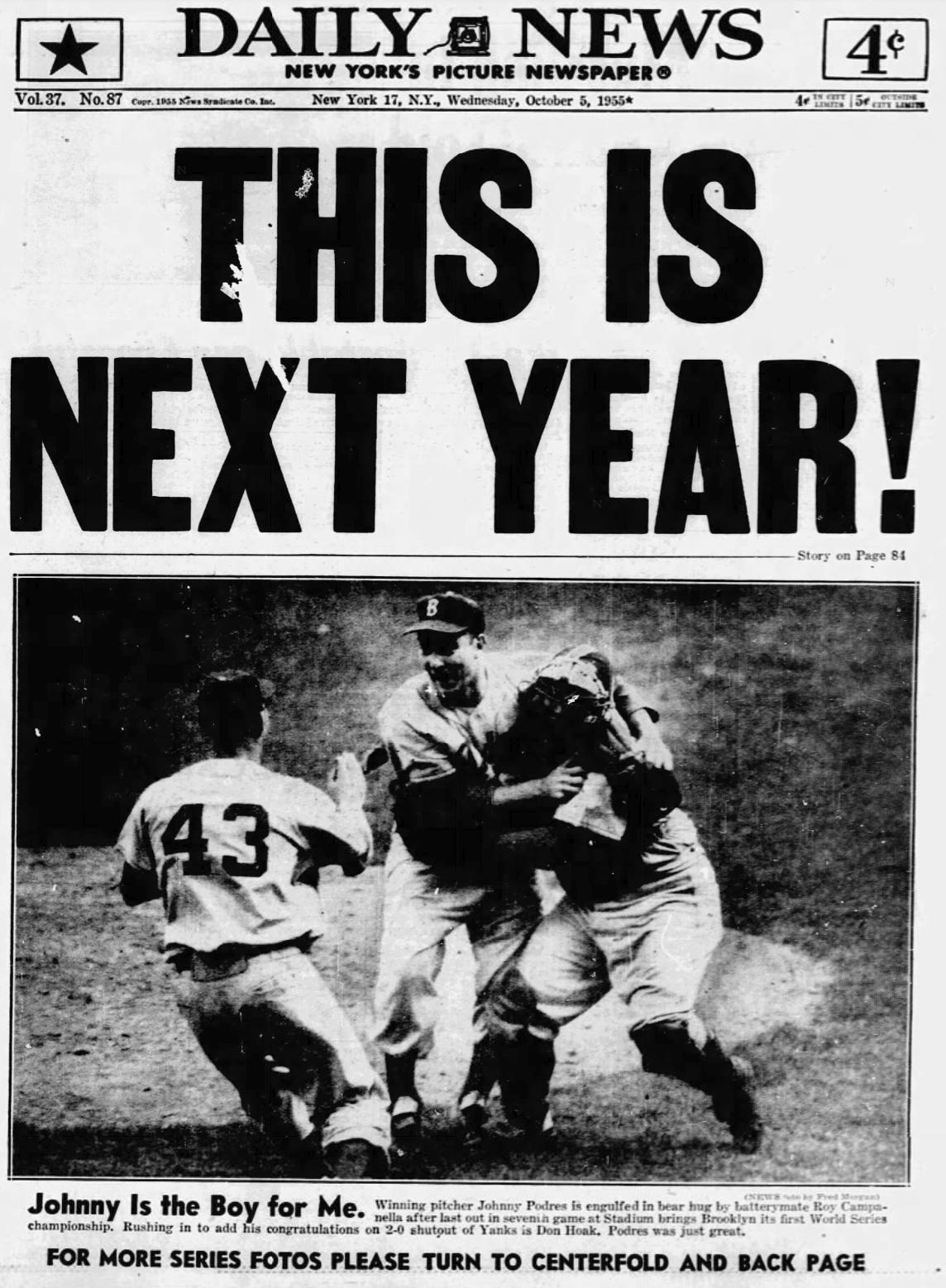
There are a few things that we’ve forgotten about the 1955 World Series over the last 70 years. As I’ve gone back through the archives, these are the points that really stood out to me:
The Dodgers really were snakebitten. There was a feeling of desperation that pervaded Brooklyn’s 1955 season. Though nobody said it, you got the feeling for the entire season that the Dodgers would need to do it this year if they were going to do it at all.
It was clear that the Dodgers wouldn’t be around forever. Brooklyn attendance was down after hitting high points in the late 1940s. There have been rumors over the years that Walter O’Malley might have taken steps to sabatoge the team in hopes of getting approval for a new stadium. What is absolutely clear, though, is that there was talk of the Dodgers playing in New Jersey throughout the 1955 season.
The Dodgers were the most popular team in North America. Newspapers all over the United States and Canada featured articles on the inner workings of the Brooklyn Dodgers. The idea that this was the team that simply could not beat whatever curse they might have had created a swelling of support for the team. And, while it’s clear the other National League fans wanted their teams to win the pennant, it’s also clear that almost the entire country was pulling for Brooklyn in the World Series.
The Dodgers had to get creative to win it. We tend to forget how Alston went against the book to finally win the title. Walter Alston tried everything, including starting youngsters Roger Craig and Karl Spooner instead of sticking Billy Loes back out there. Starting changeup specialist Johnny Podres in Game 7 was risky, but turned out to be brilliant - and I should note that we’ll probably never see a change of speed artist start a World Series Game 7 again. And the bunting attack to score the second run in Game 7 was a thing of beauty.
Sadly, as the years have gone by, the legacy of the 1955 Brooklyn Dodgers has grown faded. You no longer see people clamoring for the team to be returned to its rightful home. In fact, the Dodgers have played at Dodger Stadium for 63 years; they only played at Ebbets Field for 44.
Those who remember firsthand the magic of the 1955 World Series are 80 years old, if not older. And even if they were 90, they likely wouldn’t remember all the pain and agony that preceded Brooklyn’s rise to National League fame in 1941.
And that’s why we write and rewrite baseball history.
Quite a summary -- thanks. The Dodgers seem to have gained in popularity nationally in the late 1940s and early 1950s after breaking the color line. Obviously integrating baseball wasn't universally popular, but I think in general people liked to think that the major leagues ought to include all the best players, regardless of race or ethnicity. (One of "them" living in your neighborhood or playing on your school team was a very different issue, of course.) I notice that the byline on the Brooklyn Eagle articles in 1939 and 1940 is Tommy Holmes. He's not the future Braves outfielder, who was playing in the Yankee organization then, but according to his SABR bio, the Braves' Holmes was born and grew up in Brooklyn, hitting .613 for Brooklyn Technical High School in 1935, so I wondered whether he was a relative. Turns out Holmes the sportswriter was somewhat famous in his day; his brief Wikipedia article links to a Red Smith column when he died in 1975 (having outlived both the Brooklyn Eagle and New York Herald-Tribune, the two newspapers he wrote for), but neither the column nor the other links there mention the ballplayer.
Great read. My grandma is a die hard giants fan, Willie Mays was her favorite player as they were born in the same year. She loved the NY rivalry between the Giants and Dodgers. Happy New Year, here’s hoping it’s a good one!