

Platooning A Problem?
I came across this interesting article while studying the other day:
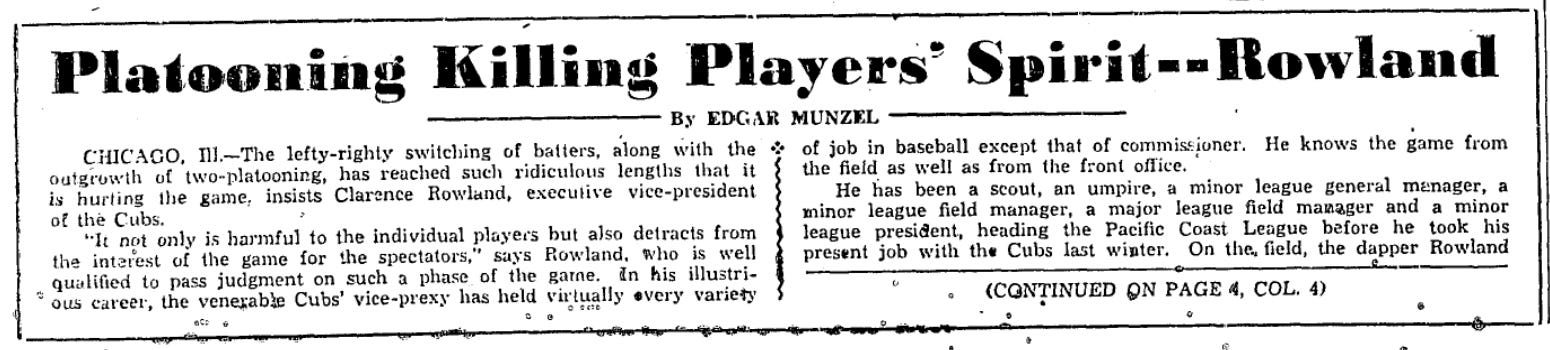
Yep, you read correctly. Forget about John McGraw, down with Tony LaRussa, and it’s time to trample the grave of Casey Stengel. The art of platooning is harmful, not helpful.
Now, I’ll admit that this sentiment is kind of appealing to me as a replayer. After all, most games don’t let you “see” the impact that hitting against a left handed pitcher has. And the games that do force that impact on you, like Replay, can be frustrating at times, since your hitter might wind up injured.
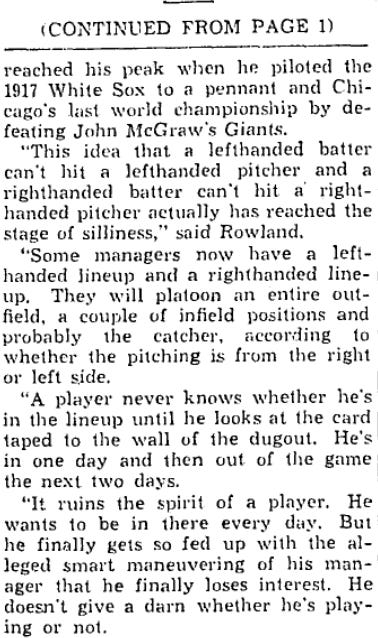
You know, Pants Rowland is a pretty interesting person to quote on this subject. The 1917 White Sox faced four straight left handed starting pitchers to start off the season - but Rowland didn’t make a single change to the lineup. It was precisely the same lineup that he used against the right handed pitchers they faced on April 16, 17, and 20 - and it was more or less the same lineup the White Sox had all season long. And it doesn’t seem that he used much platooning in the World Series, either.
John McGraw didn’t do as much platooning in the 1917 season as you might think, with the exception of Jim Thorpe. After Thorpe came back to the Giants from the Reds in late August, McGraw started him in right field against left handed starting pitchers - perhaps sensitive to Thorpe’s struggles against righties. Thorpe hit .222 in his career against right handed pitching, as opposed to .273 against lefties.
So maybe there is something to this platooning business after all.
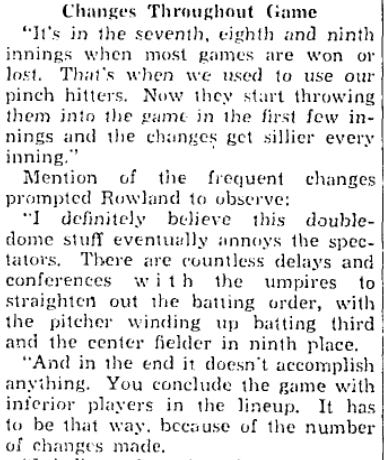
I haven’t been able to figure out a good way to look this up. However, I really don’t think you’ll find a ton of times in 1955 when players were removed in the early innings for pinch hitters simply for platooning purposes. In fact, the trend in 1955 was still to expect your starting pitcher to pitch a complete game no matter what the circumstances were.
And then there’s this:
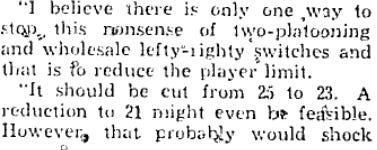
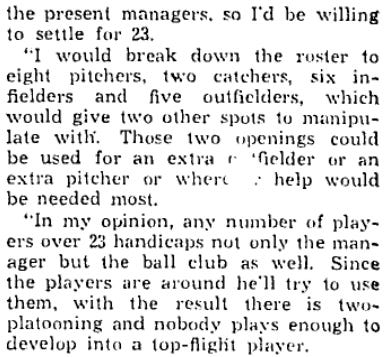
I’m not sure the Player’s Association would want to read any of this. And this is a really old school approach to managing the game, for sure.
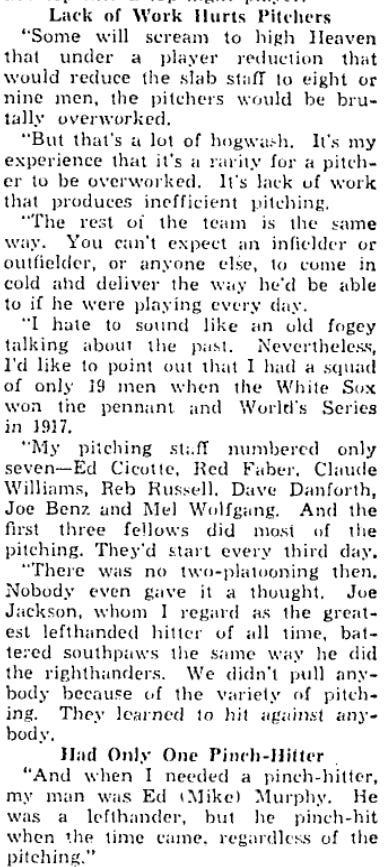
Actually, the 1917 White Sox used 26 different players all season long. Ed Murphy was used sparingly, sure. But Rowland is forgetting about catcher Byrd Lynn, catcher Joe Jenkins, first baseman Ted Jourdan, third baseman Fred McMullin, and, of course, Shano Collins, who appeared in 82 games that year for a team that used basically the same lineup game in and game out.
Rowland also forgot about Jim Scott, who started 17 games for the 1917 White Sox and had an 1.87 ERA. But he got the rest of the pitching staff correct. He actually had 8 pitchers that season, not 7.
And, of course, not everybody was pitching on short rest. It’s kind of unfair when you’ve got guys like Red Faber who would come out in relief the day after throwing a complete game, and who was more than happy to start both games of a doubleheader.
And then there’s this gem:
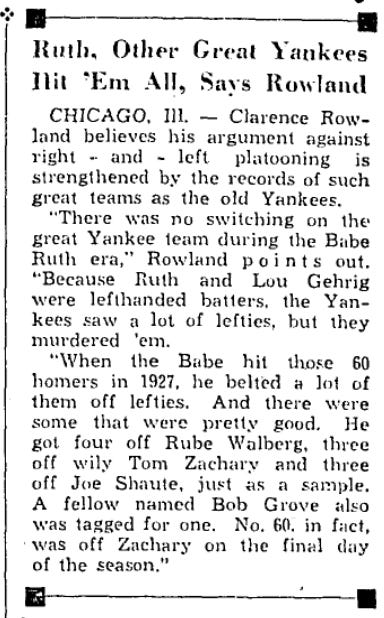
Well, yeah - if you had Babe Ruth and Lou Gehrig on your team you wouldn’t want to platoon them. But what if you’ve got Wally Backman?
The thought that some lefty hitters had trouble with southpaw pitching goes back a lot further than McGraw, let alone Stengel, a platoon player for McGraw in 1922. I've read that in 1883, APBA's one 19th century carded season -- when pitching staffs generally had three men and in-game substitutions were mostly illegal -- there were left-handed hitters who batted much higher in the order when a righty was pitching than they did against a left-handed starter. But -- those of you who have replayed early 1950s seasons can tell me whether I'm wrong -- early in-game substitutions peaked in those early 50s, when some managers would change pitchers early in games just to foul up platoon managers like Stengel -- ironically, the same concept of "openers" and "bulk pitchers" that would recur in the 2010s, though not for the same reasons. Since the second pitcher could be expected to pitch for at least a couple of trips through the batting order, it made sense to bring in substitutes to face them. Famously, Phil Rizzuto, at the end of his career, hated Stengel because he'd hit for him even before he batted for the first time if there was a pitching change.
It is interesting to read about managers of many decades ago and their approach to platooning.The stats available were limited,so much was put onto a skipper’s personal knowledge of individual matchups.going forward to the paragraph about Team player limits,MLB did just fine with 25 players.most teams carried 10 pitchers.this lasted well into the early 2000’s.