

Spinning Some Old Yarn
While looking at old issues of The Chicago Daily Tribune, I came across an article Hugh Fullerton wrote back in 1906 about bizarre baseball plays:

I was interested in seeing if I could verify at least some of these plays. And so I started to dig in. And, oh boy, all I can say is that Fullerton was an expert at spinning that yarn.
This article starts out innocously enough:
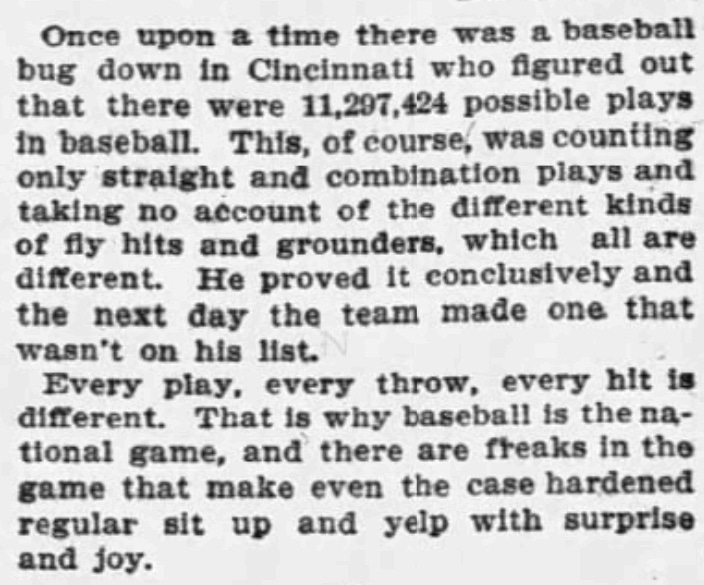
I’m sure some of you will want to fight about the math, but I’m not going to worry about it. This isn’t a numbers blog, after all.
Anyway, the first play Fullerton listed was pretty bizarre. But I don’t think it actually happened.
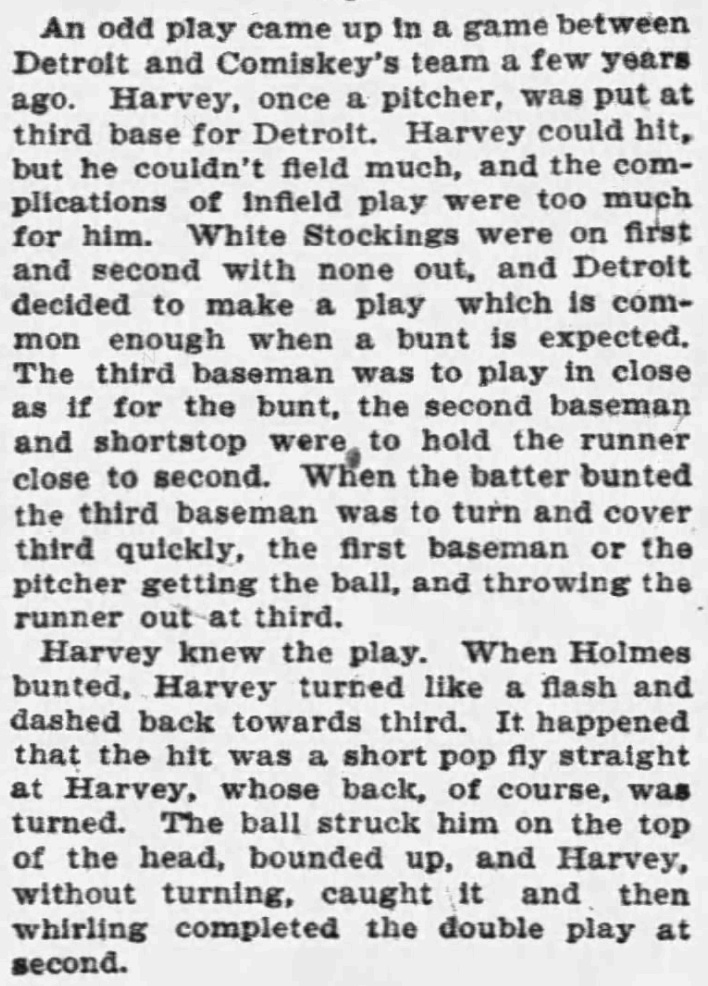
Now, the problem with this is that no man named “Harvey” played for the Detroit Tigers between 1901 and 1906.
The closest I could find was Dick Harley, who played for the Tigers in 1902. However, Harley only played left field, and never played third base. That kind of ruins the story, doesn’t it?
If it really were Dick Harley, his teammate would have had to have been Ducky Holmes.
Now, you’re going to laugh at me for doing this, but I was able to look at every batting order used by the 1902 Detroit Tigers. And the problem is that Holmes almost always hit before Harley in the batting order.
In fact, there were four possible games where this might have happened. Assuming the opponent really was the Chicago White Sox (remember that Fullerton was covering baseball in Chicago at the time), this game would have had to have been May 11, May 12, May 13, or May 19, 1902. I’ve looked through all of those game accounts and haven’t found anything even remotely like this play.
I do like the idea of a base runner completing the double play, however.
I won’t reprint the entire article, but I did want to mention this anecdote as well:
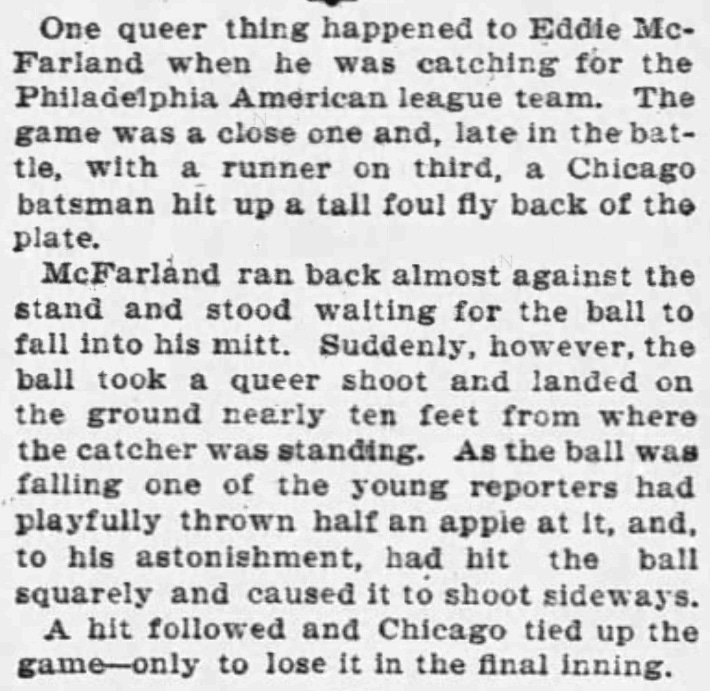
You know what the problem with this entertaining story is?
The problem is that Ed McFarland never played for the Philadelphia Athletics. And there’s no other Ed McFarland for him to be confused with.
He played for the Philadelphia National League team from 1897 through 1901, sure. He also played for the White Sox in the early years of the American League, and was actually still an active player when Fullerton wrote this.
Now, doing a textual search isn’t necessarily the best way to find this sort of thing. There’s an outside chance that there might have actually been a young reporter who somehow threw a half eaten apple all the way from the press box to make McFarland miss the foul ball.
But there are enough inaccuracies with this article to make me believe that it’s entirely fictitious.
And it’s a shame. These were some pretty good stories.
It doesn't surprise me. Baseball is loaded with so many "strange but true" stories across the decades before the era of easy Internet research that when finally examined turn out to be tall-tale embellishments of writers of an earlier age like Fullerton, or when it comes to player/umpire recollections they turn out to be fables spun for the banquet circuit (when players and umpires needed to make those appearances to make extra money in the off-season and the crowds expected to HEAR funny stories!)
Here's my favorite example of a story I was able to debunk after it had made the rounds for decades. Broadcast historian Curt Smith a few year back wrote this piece about Phil Rizzuto's broadcasting days with the Yankees that included this:
"Retrieve June 24, 1962’s Yanks at Detroit seven-hour marathon. In the 20th inning, an Ontario writer in the press box said, “I’ve got to leave.” “Where are you going?” said his friend. Writer: “My visa just expired.” Leaving in the seventh, Phil flew to LaGuardia Airport, headed to his New Jersey home, and turned on the radio. It was seven o’clock. The 1:30 game should have ended by four. “I drop my jaw, Red’s starting the 19th,” Scooter said. Mel had TV. Neither could take a leak.
"On the bridge, Phil said, “What am I gonna’ do? Should I turn around and fly back to Detroit? That doesn’t make sense.” He arrived home, kissed Cora, and turned on WPIX TV, finding Allen, in red-faced living color, still on play-by-play. Ultimately New York prevailed, 9-7, on Jack Reed’s 22nd-inning blast. In 1964, Mel was sacked, Scooter replacing him on NBC TV’s World Series. Barber bit the dust in 1966. Liberated, Rizzuto increasingly became the Yankees’ broadcast identity, forging an idiosyncratic style unlike any other."
How sure was Smith of this story's veracity? Why even Mel Allen *confirmed* it! But as it turns out, I came across a reel to reel recording of the original broadcast (the telecast audio) of this very game from the 15th inning to its conclusion and I discovered that (1) Rizzuto never left the game he was there the whole time broadcasting on WPIX (2) Rizzuto was at the mic when Jack Reed hit the only HR of his career to break the deadlock! (3) As it turned out there was a game the next day in Detroit and Rizzuto wouldn't have been flying home to begin with. Plus, Red Barber wasn't there, it was just Phil and Mel as was custom on road trips in those days!
It's a classic example of how events that took place in the era where going back to the actual broadcast wasn't possible (The fact I found this recording was a one in a billion shot) made it easier for tall tales in baseball history to surface and become part of the folklore. Today, with the game's history documented much easier and because players don't have to make speeches telling anecdotes to earn extra money, that whole phenomenon has disappeared. And of course sportswriters are a vastly different breed from the kind Hughie Fullerton was!
Probably doesn't help. but Chicago and Detroit played in the American League when it was a minor league in 1900, and both Harley and Holmes played for Detroit that year. Nobody named Harvey, though, and Harley didn't pitch or play infield. that year either. The teams would have played when it was still the Western League in 1893-99, but "Comiskey's team" was in St. Paul then; it didn't "invade" Chicago until the league prepared to go national. (Fullerton's article doesn't SAY that the team was in Chicago when this happened, or that he was there.) I can tell you that nobody named Harvey is listed anywhere in the Western League in 1899 in the Reach guide, and Harley was at Cleveland that year. (Somebody reprinted most or all of the 19th century Spalding and Reach guides about 25 years ago, but I didn't buy most of the Reach, and Spalding, who wasn't providing the official baseball to the minors, didn't cover them.)