

Storylines
I came across this ESPN tweet the other day:


It’s probably not great journalistic practice to just dump a tweet at you like this, but, hey, it’s the trend these days.
Anyway - have you ever wondered what compels people to watch certain sporting events and to skip others?
In my opinion, it’s really all about the storyline.
You probably don’t need me to tell you about the magic that was the 2016 World Series. Having a team that had not won a World Series since 1948 square off against a team that had not won one since 1908 was a magical moment, and was obviously the sort of storyline that doesn’t come around every year. And, of course, the fact that it went down to an absolutely thrilling and bizarre 7th game only added to the fun.
You kind of have to have that combination, of course. The 2005 World Series featured the Chicago White Sox, a team that had not won a World Series since 1917, facing the Houston Astros, a team that had never even appeared in the Fall Classic. However, the fact that the White Sox swept the entire Series wasn’t exactly great for the ratings.
6th and 7th games of the World Series also tend to get higher ratings. This was especially true during the late 1970s and 1980s, that magical period when television viewing had boomed and when cable and sattelite television was still rare:
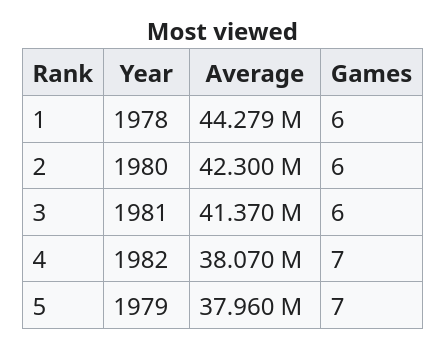
There were compelling stories those years, too. The Yankees and Dodgers met for the second straight year in 1978, and everybody was talking about when rookie Bob Welch had struck out Reggie Jackson in a pivotal moment in game 2. 1980 featured the Philadelphia Phillies, who had never won the World Series and had a history of blowing it in spectacular fashion, facing the Kansas City Royals, who had never been to the World Series before. And you can find similar compelling storylines in 1981, 1982, and 1979.
Meanwhile, the lowest viewed World Series tended to be those around the pandemic, as well as Series that didn’t offer particularly compelling storylines:
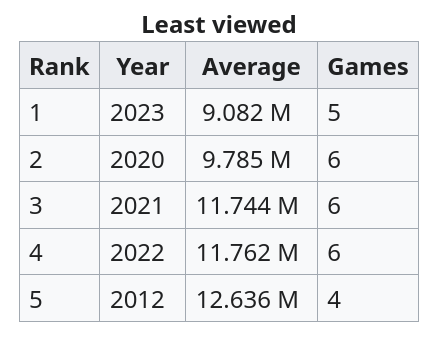
Now, the secret to all of this is that the compelling storylines are actually there, even for the ignored World Series. In 2023, for example, both the Rangers and the Diamondbacks had lost over 100 games as recently as 2021 - and the Texas Rangers franchise had never won a World Series in its 62 year history.
The question isn’t whether the storylines exist, but, rather, whether people are actually telling those stories.
And that’s one of the things we’ve got to remember about our own projects. Keeping interest long term means looking for and finding the stories that exist underneath the stats and the simulation.
I’ll put it this way. The coolest baseball card back I know of doesn’t really contain many statistics at all. Instead, it contains one of the craziest stories in baseball history, one that has been told time and time again, and yet continues to fascinate all of us:
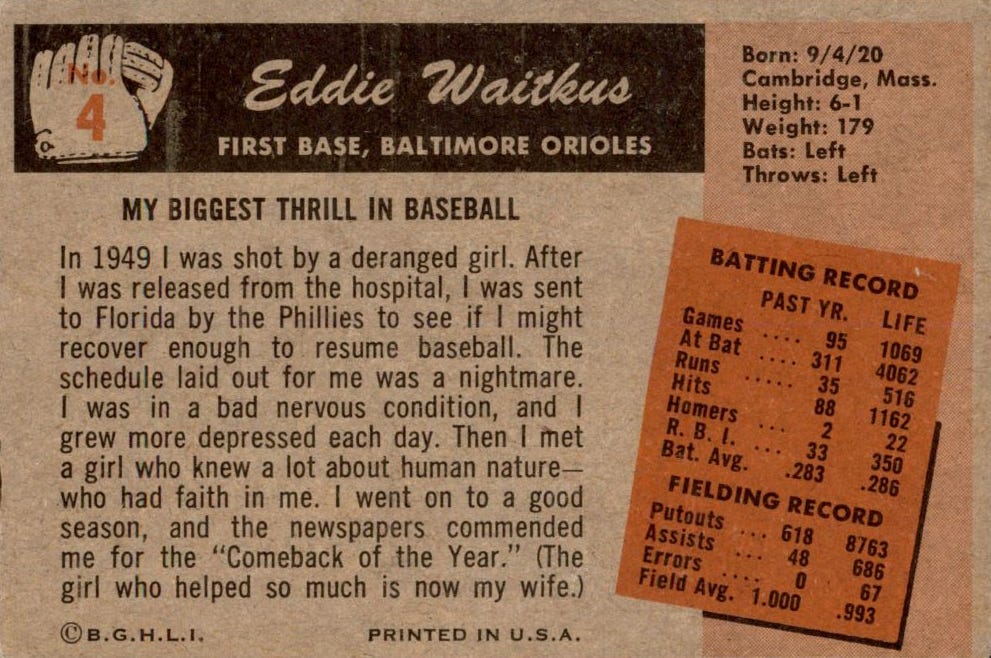
A lifetime batting average of .286 with 22 home runs tells you a little bit about the sort of hitter Waitkus was, sure. His 14.5 WAR in 11 years tells you a little bit more of the story.
But there’s no better story in baseball than “In 1949 I was shot by a deranged girl.”
The key to making a meaningful replay, or getting people to watch your World Series, is to get away from the bland statistics and find that story.
I love those 1955 Bowman "player essay backs". It's also one of my favorite sets, so I have collected a few dozen of them over the years, including Eddie Waitkus. The short paragraphs on the back of those cards capture the spirt of this post well, especially the ones that were written by the players themselves.
I think I'm an outlier. I ignore the other major sports; I only like baseball. I love the nuance and depth of the game. Someone compared baseball to the ocean. Doesn't look like all that much on the surface, but beneath that surface lies a very rich world.