

The 21 Player Limit
It wasn’t until I started a (slow moving) 1919 replay with Diamond Mind Baseball that I realized there was a 21 player limit at the beginning of that season.
I don’t know if the limit lasted the entire season or not. However, I do know that it’s absolutely there at the beginning of the season.
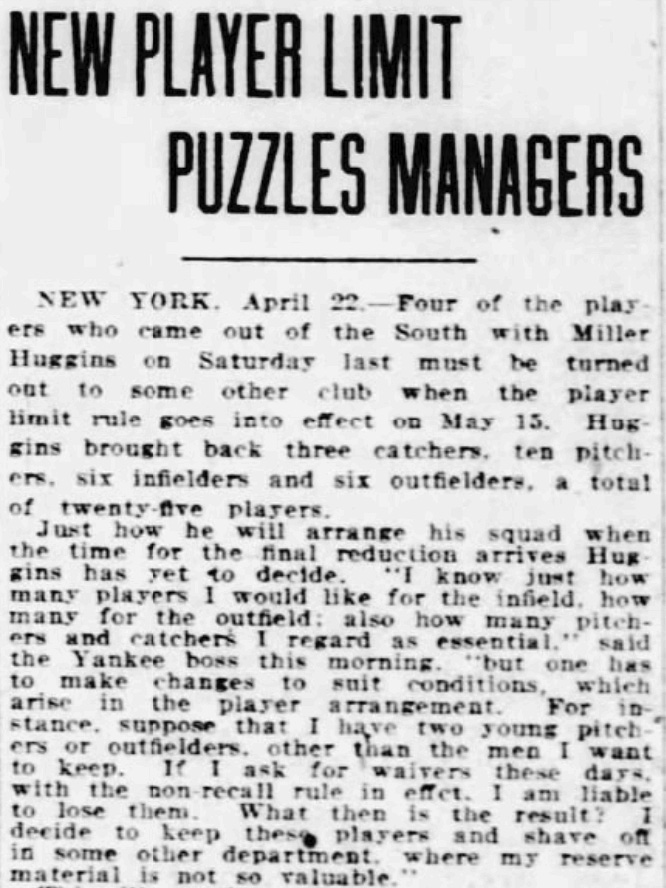
In fact, I stumbled across an article about the limit just the other day that you might find interesting - especially if you like piecing together baseball rosters on paper:
Now, those of you who are much better informed about the historic player limits in Major League Baseball can correct me here. I believe the roster limit was normally 25 men in those days, though I could be wrong.
I know that there’s a spreadsheet that has made the rounds in the OOTP community that lists theoretical roster limits. I might have a copy somewhere, and I know I’ve seen it on those forums pretty frequently. I’m not sure precisely how correct it is, however.
One thing you’ve got to realize is that managers did just about everything they could to bend the roster rules in the old days. The most famous trick was to bring a player in on a loan contract and give him a game or two. Connie Mack did this all the time with sandlot players, and, as I’m sure to see as this replay continues, the 1919 season showed him turning that trick more than in any other year.
Mack used a whopping 49 players in 1919, which was the Major League record for decades.
Of course, that’s nothing these days. But there was a time when APBA replayers who wanted a card for every single player that appeared at all had to deal with Mack’s eagerness to give time to Lew Groh, Bob Hasty, Dave Keefe, Willie Adams, and so forth.
Anyway, that was certainly against the spirit of the law of the time:
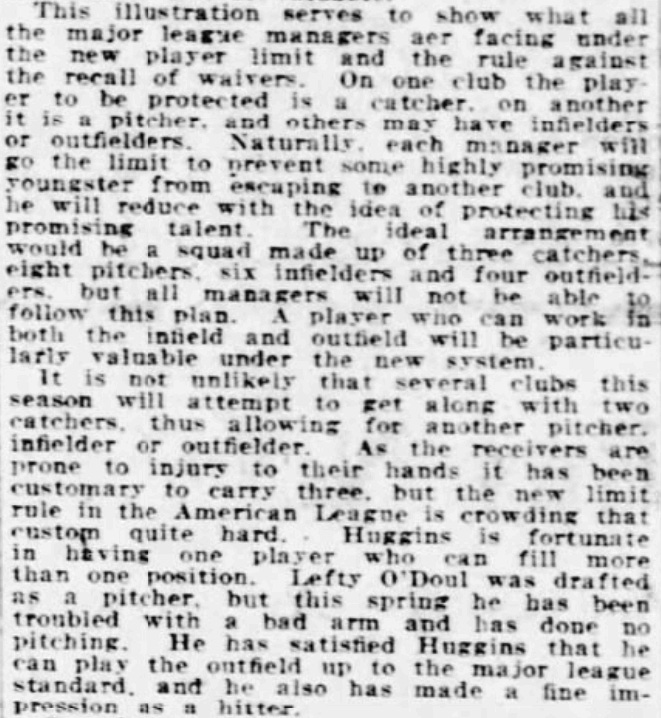
I don’t think there’s a single team in today’s Major League Baseball that could successfully get along with only 8 pitchers.
One thing we tend to forget is that pitchers pitched longer in those days in large part because they had no other choice. You had to figure out how to get guys out, and you had to figure out how to get through the innings, because there was literally nobody in the bullpen ready to relieve you.
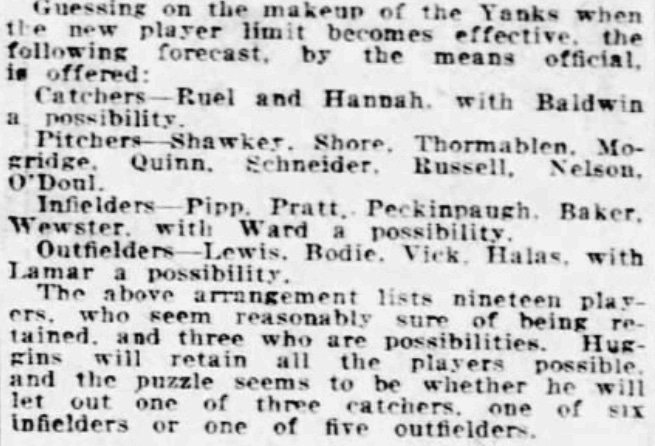
Anyway, this is what the anonymous author of this small piece thought the 1919 Yankees would look like:
That’s something to keep in mind when you sit down to piece together your own 1919 replay.
The player limit of 21 didn't start until May 15, according to the article, so Halas's four starts, for example, all happened earlier than that, and Lamar's only start for New York was on May 14. (Lamar became a regular for the Red Sox after June 30, the only player in the group to play for another MLB team during 1919.)
Despite the author's claim hat his list includes 19 players and three alternatives, it actually lists 21 and three.. So if Huggins had 25, it'd seem that this guy only eliminated one of them, and all of the reserves (including Halas and Lamar) played after May 15, though not extensively. Comparing the list to the 1919 roster on BRef, of the 24,, only catcher Baldwin didn't play, and Schneider didn't play until June 25. Don't know what conclusion to draw from that: was enforcement up to the teams rather than the league?
Thanks for the newspaper scans. The 21-man 1919 limit was news to me. But I don’t think we gamers are unaware that ye olde tyme pitchers have higher fatigue ratings than the more modern hurlers. That said, I’m probably the only gamer who found APBA and Strat-O-Matic’s old 20-man rosters acceptable. 12 batters, 8 pitchers, 4-man rotations. In my universes, an injury that cleaned out a position like catcher didn’t count until after the first sidelined player “returned,” LOL. Increasing specialization required bigger rosters, but the Big Two game companies made us pay for “additional players.”