

The Missing Link
I ran into something interesting the other day while reading through an old Bill James Baseball Abstract.
Yeah, yeah, I know that the Jamesian methods and formulas are pretty old and outdated. It’s been over 40 years since this 1984 Abstract was published. Sabermetrics has grown a lot since then, and I’m probably foolish for spending time looking back at this stuff.
However, from the point of view of someone interested in baseball simulation, there’s something interesting going on here.
As you probably know (and as some of you remember), traditional analysis of baseball offense was largely focused on batting average. And that’s why it was revolutionary for students of the game when James wrote things like this:
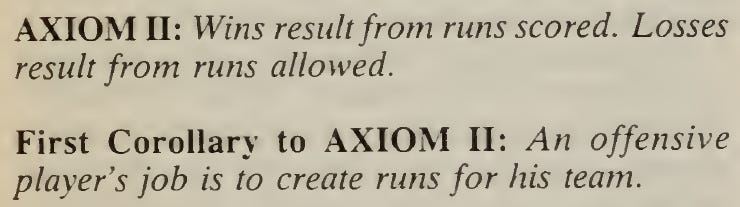
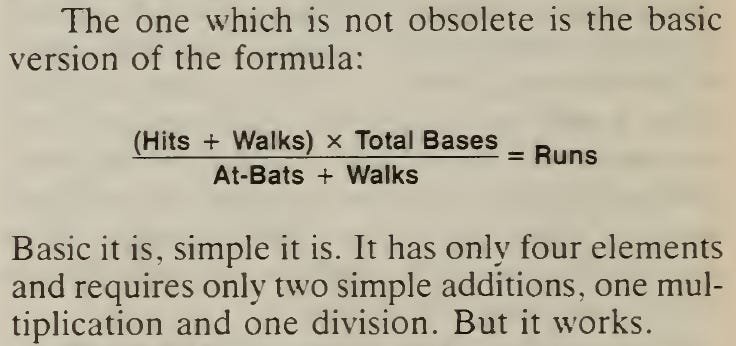
James did this to explain his infamous Runs Created formula, which I suppose we can think of these days as a precursor to something like OWAR (and, as someone who spent far too long working for the U.S. government, I honestly hate acronyms). The basic formula worked like this:
And it works in theory, too.
Scoring runs requires you to get guys on base and to get them around the bases. The “hits plus walks” part tells you about how many guys are getting on base. “Total bases” is an approximation of how they’re getting on base - it’s a measure of the total number of bases offensive players accumulate through hitting.
And, of course, you want to do this in as few outs as possible, which helps explain the bottom part of the formula. Outs are the actual “currency” of baseball, and you need to spend them wisely.
In fact, James tells us this in the same article:
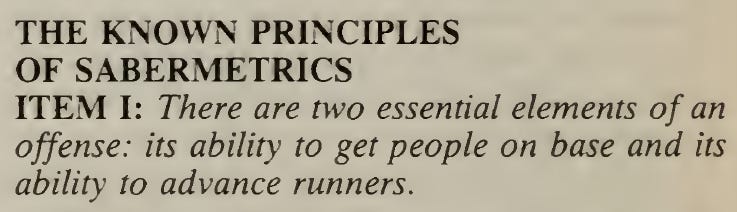

But there’s something missing in this formula, and this is where the world of baseball simulation comes in.
You see, it’s actually pretty easy to make up a baseball game where players hit similarly to how they hit in real life. It’s easy to get the singles, doubles, triples, and home runs right.
The part that we always get mixed up on is the stuff in between. Things like taking the extra base, stealing bases, being caught stealing, and good fielding preventing players from doing all this stuff.
That’s really where the baseball sims differentiate themselves from one another. The way you handle these nitty-gritty problems of the game will have a lot to do with how you model offense in different eras of baseball.
James spent years trying to tease all of the base running and fielding information out of existing statistics. We’re actually still trying to do the same thing. In fact, one of the reasons Project Retrosheet took off in the 1990s, and one of the reasons it’s so important to this day, is because it tells us a lot about how baserunning actually worked in those days.
We’re much better at keeping tabs on these stats today than we were in the past, of course. We can measure exactly where defensive players are stationed and whether the plays they make are easy or difficult based on where they are stationed. We can also measure a lot about raw baserunning ability and baserunner intelligence - all of which is ironic, of course, because baserunning is increasingly becoming less and less important in our home run dominated sport.
But, if you’re looking at any seasons before the early 2000s, you really need to start digging in. And, if you really want to understand why the players of 1908 played the game the way they played it, you need to understand the context of base running and fielding in that season.
So given this analysis can you weigh in and give us the three best baseball dice sims in your opinion 🤗⚾️⚾️⚾️⚾️
Base running, both stealing and advancing has been brought back to appreciation.